
Office Relocation in Knightsbridge: A Practical Business Moving Guide
The loading bay is booked and the lift is reserved, but the move still depends on getting people, equipment and timing aligned. Successful office relocation knightsbridge planning accounts for the building as carefully as the business, from vehicle access to the order in which teams need their workspaces ready.
Protecting equipment and limiting disruption to staff and customers are important. So are access arrangements, loading points and clear move-day responsibilities. A practical plan brings these details together early, gives staff clear instructions and helps the moving team work to an agreed sequence.
This guide explains how to plan an office move in Knightsbridge, compare relocation proposals by their scope and project fit, and organise around site access and business priorities. It also covers staff and equipment preparation, business continuity, professional packing and storage. Let’s Move London provides commercial relocations in London, with proposals tailored to the needs of your business and both premises.
Table of Contents
Why Knightsbridge office relocations need building-first planning
A business move has two jobs: transport equipment safely and keep essential operations on track. Start with the premises, not just an inventory of desks and boxes. In Knightsbridge, a shared entrance, lift booking or restricted loading point can affect the route and order of the move. If these arrangements are left until the day, the team may lose time and staff may be unsure where items should go.
A building-first relocation plan links site logistics to business priorities. Map the route from the vehicle to each office area, note any access constraints and decide which equipment needs to arrive first. For an office relocation knightsbridge project, record confirmed information separately from outstanding questions, then assign someone to resolve each question before the schedule is finalised.
Which Knightsbridge site details can shape a move?
Knightsbridge spans parts of the Royal Borough of Kensington and Chelsea and the City of Westminster. Its central London setting is part of the character of Knightsbridge, London, but practical arrangements depend on the exact premises. Don’t assume nearby offices share the same entry rules or loading options.
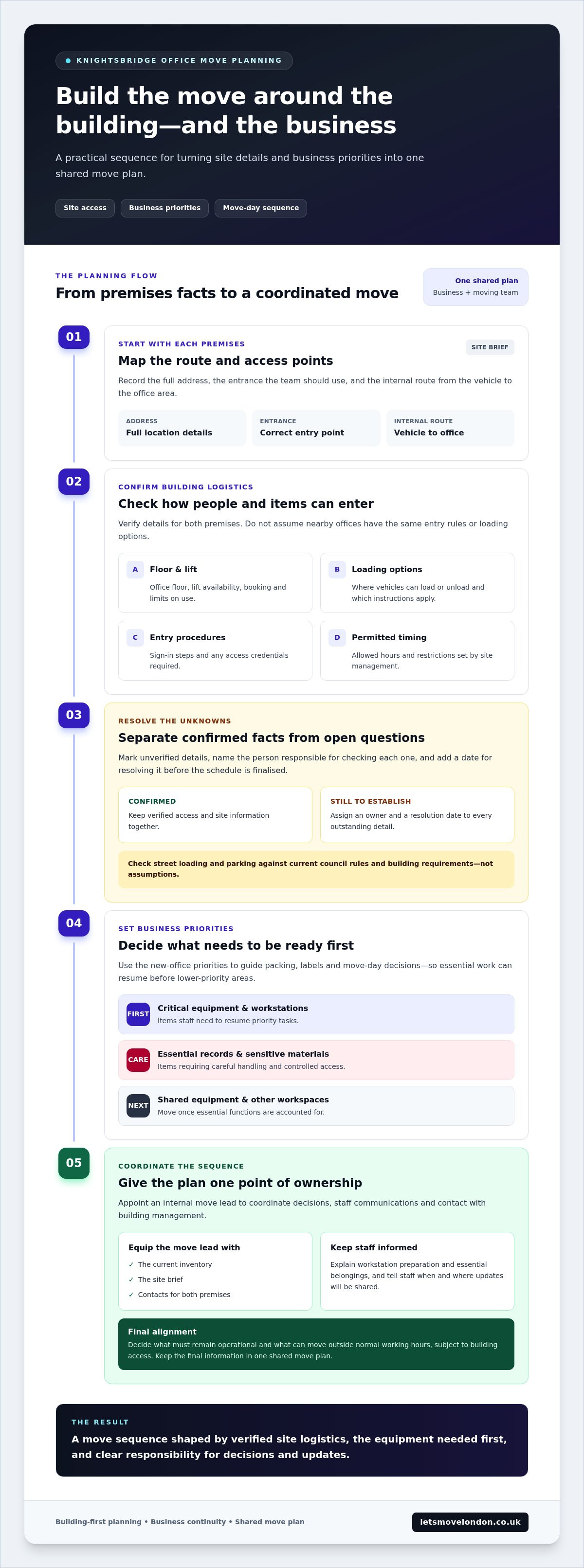
Build a concise site brief for each address. Separate confirmed details from anything the building contact or a site visit still needs to establish. Include:
Address and access points: Record the full address, the entrance the team should use and the internal route to the office.
Floor and lift arrangements: Note the office floor, whether lift access is available, how it is booked and any limits on its use.
Loading options: Establish where the vehicle can load or unload, whether there is a designated area and what instructions apply.
Entry procedures and timing: Record sign-in steps, access credentials, permitted hours and any restrictions set by site management.
Mark details that are still unverified, name the person responsible for obtaining them and add a date for resolving them. Check street loading and parking against current council rules and building requirements rather than relying on assumptions. Keep the final information in one shared move plan so the business and moving team are working from the same version.
What should a business prioritise before moving?
Decide what needs to be ready first at the new office and what can wait. This sequence guides packing, labelling and move-day decisions, and helps the team focus on the equipment needed to resume priority work. Identify:
Critical equipment and workstations staff need to resume priority tasks.
Essential records and sensitive materials that require careful handling and controlled access.
Shared equipment, meeting areas and other workspaces that can be moved once essential functions are accounted for.
Separate functions that need to remain operational from items that can move outside normal working hours, subject to building access arrangements. Set out what staff need to do before the move, such as preparing their workstation or identifying essential belongings, and tell them when and where updates will be shared.
Appoint one internal move lead to coordinate decisions, staff communications and contact with building management. Give that person the current inventory, site brief and contact details for both premises. A single point of coordination makes it easier to resolve questions and communicate changes to access or timings. With priorities and site facts in one working plan, the relocation can be organised around both the building and the business.
How to compare office relocation services for a Knightsbridge move
A useful relocation proposal connects its scope to your business’s actual requirements. It should reflect the inventory, destination and site logistics, rather than rely on a generic description that leaves you guessing about what the project covers. For an office relocation knightsbridge project, assess proposals against the same brief. This makes gaps in planning, handling or communication easier to spot.
Compare the practical elements side by side:
What should an office relocation proposal make clear?
Look for a description of the move and the information used to shape it: your inventory, collection and destination details, and relevant site logistics. The proposal should explain the planned scope and how project questions will be handled as details develop. Check that it accounts for both premises, including access arrangements, and that any assumptions or outstanding decisions are easy to identify.
Commercial relocation fees are tailored to the project. They depend on the business’s equipment, premises and requirements, so household moving prices are not a useful like-for-like comparison. Let’s Move London prepares tailored commercial relocation proposals around those project needs. UK government guidance on business relocation covers a separate issue, overseas companies moving to the UK, rather than planning a local office move.
How do packing and storage fit into the decision?
Professional packing can bring a consistent approach to preparing office belongings that need careful handling. Decide which items need packing support, who will prepare the remaining items and how those tasks fit the move sequence. Secure storage can help if there is a gap between leaving one premises and accessing the next, or if the new office cannot receive every item at once.
Include packing and storage requirements in the project scope so the proposal reflects the full move, rather than treating them as afterthoughts. For broader context on planning a London business move, visit the London moving and relocation blog. A tailored commercial proposal connects your requirements with a coordinated plan for the move.
How to protect business continuity during a Knightsbridge office move
Business continuity during an office move is a planning objective, not a promise that every task will continue uninterrupted. Build the move around the work your organisation needs to maintain, the equipment it depends on and the timing of the premises transition. For an office relocation knightsbridge project, a clear sequence helps staff understand what happens next and gives the move lead a practical way to manage decisions as plans develop.
Use this order to turn priorities into an operational plan:
Prioritise: Identify essential functions, workstations and equipment. Decide which teams need to resume work first and which items can move later.
Communicate: Appoint one internal move lead. Share agreed timings, staff responsibilities and updates through a clear channel, so questions and changes reach the right person.
Prepare: Create an inventory and destination plan. Mark sensitive materials and equipment that need planned handling, and distinguish them from items assigned to the moving plan.
Move: Follow the agreed sequence for packing, transport and delivery. Keep the move lead available to coordinate decisions with staff and the relocation team.
Resume: Set out which work areas and equipment need attention first at the new premises. Check priority functions in a planned order before teams return to their usual tasks.
How should teams prepare staff and equipment?
Give staff concise instructions that say what they’re responsible for, what they should pack, what belongs in the moving plan and when each task must be completed. Use the same instructions across departments. A simple inventory can record department, item, destination room and handling notes. For example, label a workstation with its destination room and department, then use the same room names on the floor plan and inventory.
Separate items requiring specialist internal handling, such as sensitive records or equipment governed by your organisation’s own procedures, from belongings included in the moving plan. Decide who is responsible for preparing or managing each category. Plan any technology downtime with the people responsible for those systems, and arrange secure data backups as part of business continuity preparation.
How can storage support a phased move?
Secure storage may help when the outgoing premises handover and access to the new office don’t align, or when the destination is ready for only part of the inventory. It can bridge the gap between stages, rather than requiring every item to arrive at once. Storage is an option to match to the schedule and inventory, not an automatic requirement for every relocation.
Keep a clear record of what is stored, where it belongs and what needs to reach the new office first. This helps prevent priority equipment from being overlooked during a later delivery. If storage forms part of your move, include it in the project plan and tailored commercial proposal. A coordinated moving and storage plan keeps the transition organised around operational priorities.
A Knightsbridge office relocation checklist for site access and move day
A clear checklist turns building arrangements into assigned tasks, rather than last-minute questions. Confirm how the moving team will enter, reach the office, use the lift and load or unload, then record who owns each action. Requirements differ between buildings and streets, so verify parking, loading and access arrangements with building management and the relevant local authority. Don’t assume one set of rules applies across Knightsbridge.
Essential pre-move checks include agreed access routes, lift and entry arrangements, loading plans, responsible contacts and move-day timings.
What should be confirmed with the building?
Ask the building contact to clarify site-specific arrangements and restrictions, then add the answers to the move plan. Record the contact’s name and details, plus who to approach if access or timing changes on the day. Keeping this information together gives the business and moving team a shared reference instead of leaving important details in separate messages.
Building contact: Confirm who approves deliveries, loading arrangements and access for the moving team, and note escalation details.
Business: Share the intended move date and proposed timings with building management; record approved entry procedures and any site restrictions.
Building contact: Confirm the agreed entrance, access route and lift arrangements, including any booking process or limits on use.
Moving team: Use the agreed route and timings, and follow the building’s entry instructions.
What should be ready before the team arrives?
Before move day, finalise the inventory, destination layout and labelling system. Use room or department labels that match the layout at the new premises. Check that each destination label is legible and consistent with the inventory, so the moving team can place items correctly and staff can find essential equipment after delivery.
Business: Prepare a final inventory of furniture, equipment and boxes, with destination rooms or departments clearly identified.
Business: Tell staff which belongings they’re responsible for and which items are included in the moving plan.
Moving team: Work from the agreed inventory, destination information and move-day schedule.
Business: Check current parking, loading or access requirements with the relevant authority where applicable. For premises in the Royal Borough of Kensington and Chelsea or the City of Westminster, consult the appropriate council guidance as well as building management.
Keep the final checklist accessible to the internal move lead, building contact and moving team. That shared reference can help resolve practical questions without disrupting the agreed sequence. For a carefully coordinated office relocation knightsbridge project, give the moving team your confirmed site information and inventory so the plan reflects the premises and work involved. Arrange your commercial office move.
Arrange a tailored office relocation in Knightsbridge
A well-planned commercial move brings four decisions together: site logistics, project scope, continuity priorities and proposal clarity. When those parts reflect your actual premises and business needs, you can assess the plan with greater confidence and understand what the move involves. Let’s Move London provides commercial relocations for businesses in London, with proposals tailored to the project rather than based on a one-size-fits-all assumption.
Turn your planning notes into a concise project brief. Describe the volume of items, distance between premises and practical requirements so the proposal can reflect the move. You don’t need to have every detail finalised. Share what’s known and flag decisions still in progress, such as a handover date or building access arrangement.
What information helps shape a commercial move proposal?
Prepare the details that explain the scale and setting of the relocation. Include the origin and destination addresses, an approximate inventory and preferred timing. Describe the premises as well as the items: floor level, lift arrangements, access routes, loading options and building-management instructions can all inform how the move is planned.
Move details: Addresses, preferred timing and an approximate list of furniture, equipment and other belongings.
Site information: Floors, entrances, lift access, loading arrangements and building contact details for each premises.
Business priorities: Essential work areas, items needing careful handling and any functions that should be prioritised for resuming work.
Additional requirements: Whether professional packing would support organised preparation, or secure storage could help bridge a gap between premises.
This information connects the proposed scope to the real project. It also makes it easier to see whether the plan accounts for both what needs moving and the conditions at each location.
What happens after you make an enquiry?
Let’s Move London discusses your project requirements and prepares a tailored commercial relocation proposal. This brings together the move volume, distance, site details and priorities you’ve identified, including any packing or storage needs. The proposal sets out the intended scope so you can see how it relates to your business’s requirements and what decisions remain.
Before proceeding, check that the practical details are consistent: the inventory matches the planned scope, the premises information is reflected, and continuity priorities inform the move sequence. If dates or building arrangements change, update the project plan so decisions are based on current information.
A clear brief and tailored proposal give you a practical basis for planning the next steps. Plan your Knightsbridge office relocation with Let’s Move London.
Set your Knightsbridge move in motion
Give your relocation a clear starting point by defining what your business needs for its first working day in the new office. Which teams need to be ready first? What equipment and workspaces must be in place for essential work to resume? Use those priorities to guide remaining decisions and keep the move focused on a useful outcome, not simply a change of address.
For office relocation knightsbridge planning, bring your preferred timing and key project details into one brief. Update it as arrangements progress, and share changes with the people coordinating the move. A common reference helps your team respond to changes while keeping decisions aligned with business needs.
Let’s Move London can prepare a commercial relocation proposal around your project requirements. Plan your Knightsbridge office relocation with Let’s Move London by sharing your move details, site arrangements and priorities.
Frequently Asked Questions
How do I plan an office relocation in Knightsbridge?
Set business priorities first, then build an inventory and confirm collection and destination details. Identify essential services, staff needs and items requiring specific handling. Next, coordinate the move sequence with your moving team and building contacts, including entry, lift and loading arrangements. For office relocation knightsbridge planning, check site-specific rules with building management and the relevant authority, as access and local requirements can vary by address.
What should I look for when comparing office relocation companies?
Compare each proposal against the same project brief. Check that its scope identifies what’s being moved and between which premises, then assess how planning accounts for the inventory and site constraints. Review the handling approach, who will coordinate updates, and how clearly the proposal explains inclusions and assumptions. This helps you judge whether the described work matches your operational needs, rather than comparing headline quotes without understanding their scope.
Can an office move be planned to minimise business disruption?
Yes, careful sequencing and staff communication can help manage disruption, but no plan can promise zero downtime. Identify essential services, such as customer support or access to a core business system, and plan their equipment and workspace transition around operational priorities. Give staff clear instructions and a named contact for move-day questions. The right approach depends on your business, premises and project scope, so plan contingencies for critical tasks.
Do Knightsbridge office moves need special parking or loading arrangements?
Requirements depend on the exact address, building and current local rules. One premises may have designated delivery access, while another may need a different arrangement. Confirm building entry and loading procedures with site management, then check applicable requirements with the relevant local authority, such as the Royal Borough of Kensington and Chelsea or the City of Westminster, depending on the address. Don’t assume a permit or restriction applies across all of Knightsbridge.
Can storage help if office move dates do not line up?
Yes. Secure storage can bridge a gap if you need to leave one office before the new premises can receive all your furniture or equipment. It may also suit a phased move, with essential items delivered first and the remainder moved when the destination is ready. Treat storage as a project-specific option and plan what needs retrieving and when. For broader planning ideas, see the London secure storage guide.
What information should I prepare to get an office relocation proposal?
Prepare the collection and destination addresses, an approximate inventory and your preferred timing. Add site details such as office floors, lift access, loading arrangements, entry procedures and building-management contacts. Note equipment requiring planned handling, and whether professional packing or secure storage would help. This information gives the relocation team context to shape the project scope. Commercial relocation fees are tailored to project requirements, so share enough detail to reflect the work involved.
How far in advance should a Knightsbridge office move be planned?
Begin planning once you know the likely move date and premises details; there isn’t one lead time that suits every office. A smaller move with straightforward access differs from a larger project involving several departments, shared building arrangements or phased delivery. Starting early gives you time to coordinate internal priorities, site arrangements and staff communication. If dates are still provisional, gather inventory and access information first, then update the plan as decisions firm up.



Comments