
Long term storage in Croydon with unit size options
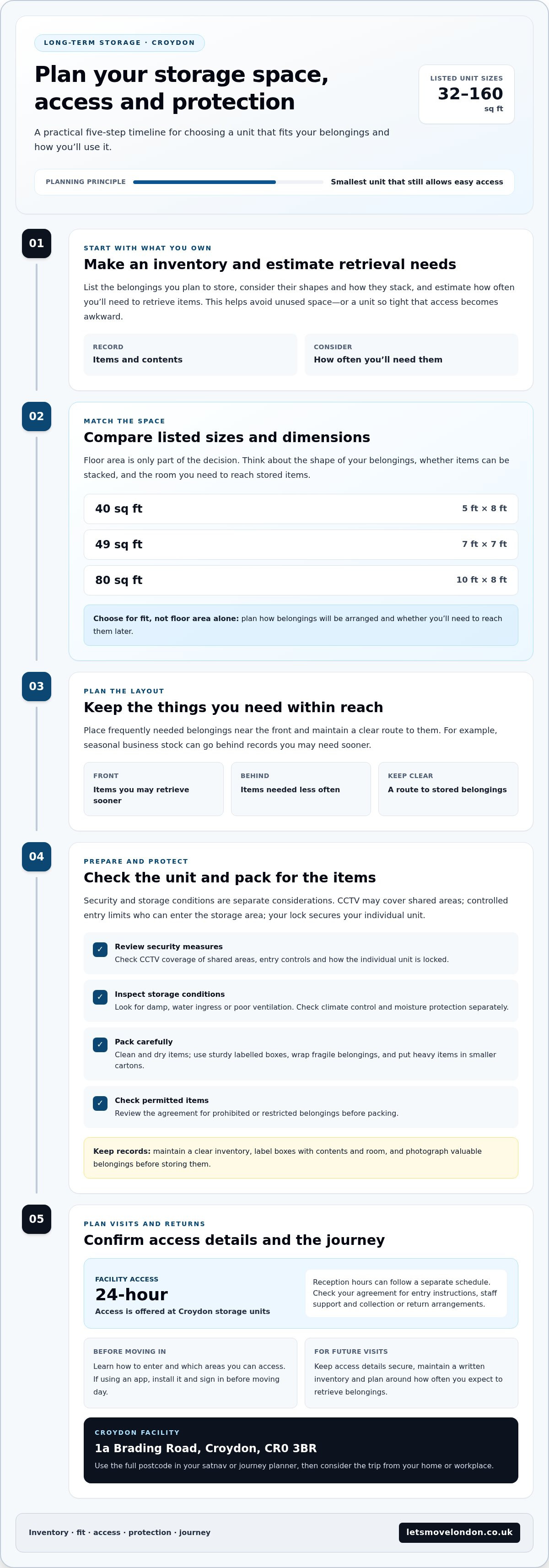
The right storage unit is the smallest one that fits your belongings without making access awkward. For long-term storage in Croydon, listed unit sizes range from 32 sq ft to 160 sq ft, with options including 40 sq ft (5ft × 8ft), 49 sq ft (7ft × 7ft) and 80 sq ft (10ft × 8ft). The best fit depends on what you’re storing and how you plan to arrange it.
It’s easy to focus on floor area alone, but the shape of your belongings, how they stack, and whether you need to reach items later all affect the space you need. Make an inventory and estimate how often you’ll retrieve things. This helps you avoid paying for unused space or cramming belongings into a unit that’s too small.
This guide explains how to estimate the space you need, organise access, and plan for collecting your belongings. It also covers practical considerations for long-term storage in Croydon, including how often you’ll travel to the facility. Use these steps to plan around your belongings and your next move.
Table of Contents
Storage access and returns by arrangement
Access affects how you should organise belongings for long-term storage. Croydon storage units offer 24-hour access, so you can plan visits outside standard reception hours. Arrange a return around your schedule, and keep frequently needed items near the front. For example, place seasonal business stock behind records you may need sooner.
Access arrangements depend on the facility and your agreement. Before moving belongings in, learn how to enter, which areas you can access, and how to arrange collections. Keep access details secure, and maintain a clear inventory so you can find items quickly.
For practical ideas on planning a storage rental, watch this video:
Reception hours and storage access hours may differ. A facility might have staffed reception at set times but allow access at other times. Check your agreement for reception hours, entry instructions, and arrangements for collecting or returning items. This distinction matters if you need staff help with a delivery or account query.
App entry is one way to manage access. If you need an app, install it before moving day, sign in, and keep your phone charged. Keep a written inventory separately so you can identify boxes without relying on your device. If you use a keypad or key, protect the code or key and don’t label it with your unit details.
CCTV and controlled entry are different security measures. CCTV can monitor shared areas, while controlled entry limits who can enter the storage area. Review the facility’s security information and check how your own unit is locked. Camera coverage does not necessarily mean every unit is monitored directly.
What items are prohibited or restricted in long-term storage? Facilities commonly restrict hazardous or flammable materials, perishable food, living things, and items that could leak or attract pests. Check the storage agreement’s prohibited-items rules before packing.
How should you prepare and pack belongings? Clean and dry items first, then use sturdy boxes labelled with their contents and room. Wrap fragile items, pack heavy belongings in smaller cartons, and leave a clear route to anything you may need to retrieve.
What should you check in a long-term storage contract? Read the terms for access hours, permitted items, payment arrangements, notice for ending storage, and the process for collecting belongings. Keep a copy with your inventory and access instructions.
How accessible are Croydon storage facilities, and what are their opening hours? Croydon storage units offer 24-hour access, while reception hours can follow a separate schedule. Plan your visit around the entry method and any staff support you need.
Security features
For long-term storage in Croydon, assess protection as a combination of separate measures. CCTV, controlled entry, a strong unit lock, and suitable storage conditions address different risks. A camera may cover shared areas without showing the inside of your unit. Entry controls manage access to the building, while your lock secures the individual unit.
Are Croydon storage units climate-controlled, dry, and secure? Consider climate control, moisture protection, and security separately, both for the facility and the individual unit. These are different features, so don’t assume one guarantees the others.
Use a practical checklist during your decision:
Identify where CCTV cameras are positioned and which shared areas they cover.
Understand how entry to the centre is controlled and how your unit is locked.
Check the unit for signs of damp, water ingress, or poor ventilation before placing belongings inside.
Choose packing materials that suit the items, such as protective covers for furniture and sturdy boxes for equipment.
For example, a camera facing a corridor may record movement near storage units, but it won’t show how boxes are stacked inside. Keep an inventory, label containers clearly, and photograph valuable belongings before storing them. This makes it easier to identify items and notice changes when you return.
Protect belongings from moisture by storing only clean, fully dry items, and avoid sealing damp items in plastic. Raise boxes off the floor using suitable supports, and leave space between belongings and walls. For clothing, paperwork, or electronic equipment, use packaging suited to those materials. Don’t place heavy boxes where they could crush lighter or delicate items.
Your routines also play a part in security. Keep keys or entry credentials separate from unit details, and share access only with people who need it. Close and lock the unit after each visit. Update your inventory when you remove business stock or add belongings, so it reflects what remains.
A unit that seems affordable may not suit belongings that need specific environmental conditions. Match the unit size to your items, then consider the protection each one needs. Choosing a larger space won’t solve moisture or temperature concerns. For secure storage, focus on the unit’s condition, the entry process, and the facility’s stated measures.
Before booking long-term storage in Croydon, compare the written security and environmental details with your inventory. Note which belongings need extra wrapping, sealed containers, or a different arrangement. This gives you a clear preparation plan and helps protect your items while they’re stored.
Don’t assume a unit is climate-controlled, dry, or secure without checking each feature. Look for damp or water ingress, and review the facility’s access controls and the lock on the individual unit.
Storage facility location and nearby areas served
The Croydon storage facility is at 1a Brading Road, Croydon, CR0 3BR. Use the full postcode in your satnav or journey planner, then check the final approach before loading household belongings. A postcode gives you a clear destination, while your starting point and travel method determine the most convenient route.
If you’re visiting from South Croydon, plan the journey around your vehicle, collection time, and load size. A car carrying a few boxes needs different arrangements from a van carrying furniture. Save the address on your phone and keep it with your moving inventory.
East Croydon Station is London's busiest station outside Zone 1. It can be a useful reference point when planning travel across Croydon, but don't assume it is beside the facility. Compare your route from the station or your home address, and allow time to transfer belongings between transport and the storage centre.
How suitable a nearby facility is depends on how often you expect to visit. If you live or work around Croydon, consider whether it fits your regular route. For less frequent visits, weigh the journey against the convenience of keeping household items, furniture, or business stock near where you’ll need them.
What long-term self-storage facilities are available in Croydon? The facility at 1a Brading Road, Croydon, CR0 3BR, provides a local point to consider for storage. Compare its location with your home, workplace, and likely collection route to judge whether it suits your plans.
What are the minimum rental periods and notice requirements in Croydon? These are set out in the storage agreement. Read the rental-period and notice terms together, especially if your moving date or return schedule might change.
What insurance is required or included for stored belongings? The agreement explains whether cover is included or required and which belongings it applies to. Check the insured value, exclusions, and claims process against your inventory before storing items.
Before arranging a move, make a simple location plan:
Save the full Brading Road address and postcode in your journey planner.
Choose a route from your home or workplace, including South Croydon if relevant.
Match your vehicle and loading plan to the belongings you’re transporting.
Keep the rental and insurance terms with your storage inventory.
These steps help you assess whether a Croydon facility works for both delivery and collection. A convenient address is one that fits your usual travel route and the way you plan to move belongings in and out.
Croydon Palace served as the summer residence of the Archbishop of Canterbury for over 500 years. This history offers a point of interest alongside practical decisions about access, loading, and planned visits. If your trip includes time to explore, keep that separate from the journey to the facility, and check your route and schedule before setting out.
Storage unit sizes and dimensions
Choose a unit by measuring furniture, boxes, and the floor space needed for access. Croydon storage options range from 32 sq ft to 160 sq ft. The right unit size depends on the volume and shape of your belongings, plus whether you’ll retrieve items during the rental. A stack of uniform boxes uses space differently from a sofa, wardrobe, or irregular equipment.
Listed Croydon dimensions give you a practical comparison:
32 sq ft is the smallest listed unit.
40 sq ft measures 5ft × 8ft.
49 sq ft measures 7ft × 7ft.
56 sq ft measures 7ft × 8ft.
80 sq ft measures 10ft × 8ft.
104 sq ft measures 13ft × 8ft.
160 sq ft measures 20ft × 8ft, the largest listed unit.
Use the floor dimensions to sketch a simple layout before moving items in. Group boxes by room and measure larger furniture separately. Leave space to reach belongings at the back: a unit packed wall to wall may hold more, but makes retrieval harder. If you’re storing belongings while away, keep the items you’ll need on your return near the entrance.
Think in terms of usable space, not just the unit’s area. A 49 sq ft square layout differs from a 40 sq ft unit measuring 5ft × 8ft. Long furniture may fit one shape more neatly, while boxes can stack efficiently in another. Confirm the height and access layout as part of your planning, and don’t estimate bulky items from photographs alone.
For long-term storage in Croydon, make an inventory and sort it into three groups: large furniture, stackable boxes, and items you’ll need again. Measure large pieces and note which boxes can safely stack. This helps you choose between nearby unit sizes and plan the load without blocking frequently used belongings.
The price depends on the case and is given after a quote request; unit size, rental duration, and access arrangements affect the quote. Discounts for long-term rentals are set by each provider and may depend on rental duration and selected unit size. Compare the quoted total and its terms rather than assuming a longer rental automatically reduces the cost.
A measured plan can help you avoid a unit that wastes space or makes access difficult. In South London, consider the journey as well as the dimensions: loading furniture into a larger unit takes different planning from storing labelled boxes. Match the space to your inventory, leave a practical route inside, and keep a copy of your layout with your records.
Storage service areas around Croydon
A storage address tells you where belongings are kept, not which neighbourhoods a service covers. The Croydon facility is at 1a Brading Road, Croydon, CR0 3BR. Use that address as your route-planning point, then compare it with home, work, or your next destination. This separates facility location from the practical question of how belongings reach it.
Start with the collection address and the belongings involved. A student moving out of a Croydon room may have boxes and a small desk, while a household relocating nearby may need to move larger furniture. The load affects the vehicle, loading time, and assistance required. Make an inventory before deciding how to transport your belongings.
Consider the whole journey, not just the distance on a map. Note parking and loading arrangements at the collection address, then plan how you’ll unload at Brading Road. Carrying boxes from an upper-floor flat takes different planning from loading furniture beside a ground-floor entrance. A route suited to a car may not work for a larger vehicle.
Nearby residents can use this simple area-planning checklist:
Write down the collection address and the Croydon facility address.
List bulky items separately from boxes, so the load is clear.
Plan the route and loading method for both collection and return journeys.
Keep important items accessible if you’ll need to collect them during storage.
This approach works for household moves, student belongings, and business stock. If you’re travelling from outside Croydon, weigh the journey against how often you’ll visit. Frequent visits make travel time more important, while a one-off drop-off may depend more on organising the load and return date. Choose storage to suit your actual needs, rather than assuming that any nearby facility will work.
An area name alone doesn’t determine collection or delivery arrangements. Start with the Brading Road address, then plan how your belongings will get there. The route, volume of items, access at each address, and assistance you need all shape the plan. Keep these details together to make collection and later retrieval straightforward.
Before moving day, finalise your inventory, transport plan, and collection order. Place the boxes you’ll need first where you can reach them without unloading everything else. Whether a household is collecting furniture or a student is picking up belongings between terms, a clear order can make the trip easier to manage.
Use the storage planning advice to organise your next steps around the Croydon location and your load.
Let's Move London: Moving
Let's Move London provides moving and storage for household and business transitions. If belongings need to leave one property before the next is ready, storage can bridge the gap. Moving support can help coordinate your change of address with the time your items are stored.
Prepare an inventory, note which belongings you’ll need first, and decide what should go directly to your new property. This makes it easier to plan how moving and storage fit together, whether you’re relocating a home or reorganising business space. Share the key details of your move and storage needs to discuss a practical next step.
Contact Let's Move London or visit letsmovelondon.co.uk to discuss your plans.
Plan your next move with confidence
Treat storage as part of your transition plan, not a separate task. Decide which belongings will stay packed, which need to travel with you, and when you expect to use them again. This simple sequence can make long-term storage in Croydon easier to manage during a home move, refurbishment, or business reorganisation.
Let’s Move London provides storage and moving, with man and van support for transport. Bring together your expected dates, an outline of what you’re storing, and any collection or return plans. These details are a useful starting point for discussing how storage can fit around your next move.
Take the next step when you’re ready. Contact Let’s Move London about storage and start planning a practical arrangement for your belongings. A clear plan now can help you move forward with greater peace of mind.
Frequently Asked Questions
What size storage unit do I need?
Choose a unit based on the total volume of your belongings and how you’ll arrange them. Measure bulky items such as beds or wardrobes, then estimate how many boxes will fit around them. Leave space to reach items you may need during storage. For example, keep boxes you’ll collect soon apart from furniture and seasonal belongings that can stay packed.
How much does long-term storage cost in Croydon per month?
The monthly cost depends on your requirements. Unit size, rental duration, and access arrangements all affect the price. To make your request useful, prepare an inventory and note how long you expect to store your belongings. Include large items such as wardrobes or appliances so the quote reflects the space you need.
What unit sizes are available, and how much space do I need?
Listed Croydon units range from 32 sq ft to 160 sq ft. Options include 40 sq ft (5ft × 8ft), 49 sq ft (7ft × 7ft), 56 sq ft (7ft × 8ft), 80 sq ft (10ft × 8ft), and 104 sq ft (13ft × 8ft); the 160 sq ft unit measures 20ft × 8ft. Match the area to your inventory, item shapes, and access needs.
Are Croydon storage units climate-controlled, dry, and secure?
Assess climate control, moisture protection, and security separately; don’t assume the unit has these features. Look for damp or water ingress, and review the facility’s access controls and the lock on the individual unit.


Comments