
How to Claim for Damaged Furniture After a Move in the UK
Your furniture arrives with a fresh scratch or a damaged leg, and you’re left wondering whether it happened during the move. Knowing how to claim for damaged furniture after a move uk starts with recording what you can see before moving or repairing the item. Clear photos and a prompt written report can help establish what happened and when.
It’s understandable to worry that a moving company may dispute the cause of damage. Note the item’s condition, keep relevant paperwork and describe the issue factually. If you’re still at the property, record the concern on the job sheet or move paperwork where possible, and keep a copy or photograph.
This guide explains how to document furniture damage, report it clearly and follow up. Insurance is included with every move by Let's Move London. This does not guarantee a particular claim outcome, so keep your report accurate and provide the evidence you have.
Key Takeaways
Record visible damage before cleaning, repairing or moving the furniture, and keep clear photographs.
Separate what you observed from assumptions about when or how the damage happened.
Prepare a concise report with the move details, an item description, when you noticed the damage and relevant evidence.
Ask the moving company to acknowledge your report and explain the next communication step.
Insurance is included with every Lets Move London move, but it does not guarantee a particular claim outcome.
Table of Contents
Furniture damaged after a move: what to do first
Finding a fresh mark, cracked panel or loose leg after a move can be upsetting, especially when you’re not sure when it happened. Start by recording the facts. A calm, evidence-led account gives you a clearer basis for discussing the damage with the moving company.
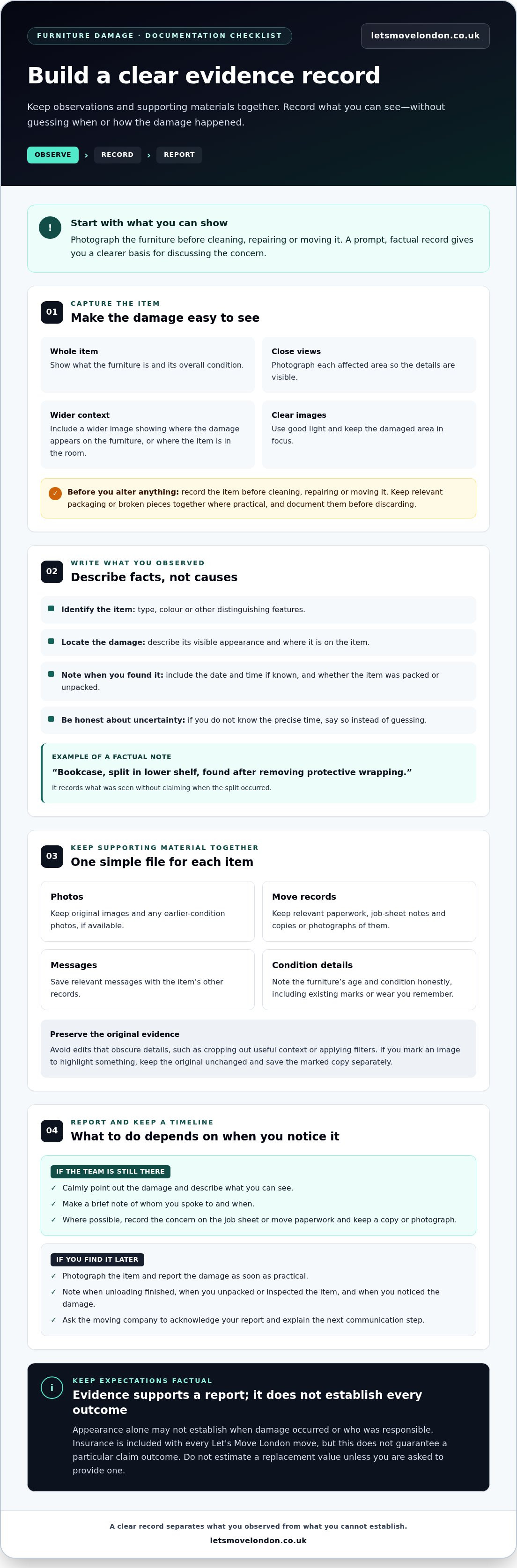
Photograph the item before cleaning, repairing or moving it. If you notice damage as the furniture is unloaded, record it straight away. If you spot it later while unpacking, note when you discovered it and what you were doing. Don’t guess how or when it happened. Prompt documentation creates a clearer record of the concern.
This video offers a general overview of filing a damage claim after a move:
What to record when you first notice damage
Take a photo of the whole item so its identity and overall condition are clear, then take close-ups of each affected area. Include a wider image showing where the furniture is in the room. These views provide context without requiring you to speculate about the cause. A general overview of what a moving company does may explain the service context, but your report should focus on this move and the evidence you have.
Write down the item’s description, the visible damage and when you discovered it. For example, describe a “wooden dining table, chipped corner on the right side, noticed during unloading” rather than stating who caused it. Keep related packaging or broken pieces together where practical, and don’t discard them before you’ve documented them.
Should you report damage before the movers leave?
If you notice damage while the team is still working, calmly point it out and describe what you can see. Make a brief note of whom you spoke to and when. If there’s a job sheet or other move paperwork, record the concern there where possible and keep a copy or photograph for your records. Keep the conversation factual, even if you’re concerned about how the damage occurred.
If you discover damage after the team has left, report it as soon as practical. Photograph the item and explain when you first saw the issue. A simple timeline can help: when unloading finished, when you unpacked or inspected the furniture, and when you noticed the damage. A clear sequence is more useful than an uncertain explanation.
When considering how to claim for damaged furniture after a move uk, start with what you can show: the item, the damage, when you discovered it and any relevant paperwork. Insurance is included with every move by Lets Move London, but this doesn’t guarantee a particular claim outcome. A prompt, factual record helps the team understand your concern and consider the information you provide.
Build a clear evidence record for damaged furniture
A tidy, consistent record makes it easier to explain your concern and respond to follow-up questions. Keep the information for each affected item together rather than relying on memory or searching through scattered messages. The aim is to show what you observed and what supports your account, not to prove a cause you can’t establish.
An evidence record is a dated collection of observations and supporting materials about an item. Keep original photographs and written notes together, and retain copies of relevant move paperwork and messages. Avoid editing images in ways that obscure details, such as cropping out useful context or applying filters. If you mark an image to highlight a detail, keep the original unchanged and save the marked copy separately.
Photographs and notes that make the damage easier to understand
Use good light and take both an overall image and close views of the affected area. Make sure the damage is in focus, and include a wider view showing where it appears on the furniture. Write a plain description such as “scrape along the left side”, “dent in the table edge”, “split in the chair leg” or “broken handle”. Avoid labels like “careless handling”, which suggest a cause rather than describe what you can see.
Add the date and time you noticed the damage, and state whether the item was still packed or had been unpacked. If you aren’t sure of the precise time, say so instead of guessing. A clear note might read: “Bookcase, split in lower shelf, found after removing protective wrapping.” This records what you saw without implying when the split occurred.
Useful records to keep with your report
Build a simple file for each affected item. Include any pre-move images that show its earlier condition, if available, along with relevant move paperwork and messages. Note the furniture’s age and condition honestly, including any existing marks or wear you remember. Don’t estimate a replacement value unless you’re asked to provide one. Citizens Advice offers broader guidance on damaged items and compensation; keep your moving report centred on the evidence for your particular item.
Item: identify the piece clearly, including its type and colour or distinguishing features.
Observation: describe the visible damage and where it appears.
Timeline: record when you found it and whether it had been unpacked.
Supporting material: group original photos, earlier-condition images, paperwork and relevant messages.
This structure helps you explain the damage without mixing documented facts with assumptions. If you’re preparing for a move in London, learn about moving with Lets Move London. If you’re reporting damage after a move, have your item record ready when you contact the team.
How to assess the damage and set realistic claim expectations
Assess the furniture by separating what you can see from what you think may have happened. A new-looking scrape or loose component is worth reporting, but appearance alone may not establish when it occurred or who was responsible. A measured account helps the company understand your concern without turning uncertainty into an accusation.
An assessment depends on the reported facts and evidence, not on an assumed result. Describe the issue clearly, provide the material you have and allow the company to consider it before drawing conclusions.
Separate visible damage from assumptions about its cause
Use precise, neutral language. “The table has a fresh-looking scrape on its front edge” describes an observation; “the movers scraped it” assigns a cause. Unless you directly saw damage occur, keep that distinction clear. If a component feels loose, say which one and what you noticed rather than assuming it was broken during handling.
Where information is missing, record it as a question. For example: “I didn’t see this area before unpacking. When did the damage occur?” This is more useful than filling the gap with a guess. Explain the timeline you remember while making clear which details you can’t verify.
Use a simple fact-and-evidence comparison
Organise your account by matching each observation with its support and any remaining uncertainty. This makes the difference between evidence and interpretation easy to see:
Observed fact: A chip is visible on the cabinet’s lower corner.
Supporting evidence: A close photograph shows the chip, and a wider photograph identifies its location on the item.
Unanswered question: The exact point at which the chip occurred is unknown.
Repeat this format for each separate issue. Don’t combine unrelated marks into a general claim of “damage”; describing them individually keeps the discussion specific. If you have an earlier image, note what it shows without claiming it proves more than is visible.
Why a reported claim does not guarantee compensation
Insurance is included with every Lets Move London move. That is a confirmed service feature, not a promise that every reported concern will result in compensation. The outcome depends on the details of the individual situation and the information available. Avoid assuming a particular result before the concern has been considered.
Don’t try to calculate compensation or apply coverage rules you haven’t been given. Instead, send a factual description, relevant supporting material and any unanswered questions. If the team asks for clarification, answer directly and distinguish what you remember from what you can demonstrate. This keeps the conversation clear and gives the reported concern an evidence-led basis for review.
How to submit a furniture-damage report and follow it up
Once your notes and photographs are organised, send a clear report to the moving company. A concise message helps the team identify the move, understand what you found and see which evidence supports your account. Keep the tone respectful and stick to what you observed, even if you’re concerned about how the damage happened.
Identify the move. Give the customer name and move date, along with any other details that help the team locate the booking.
Describe the furniture. Name the item and point out the visible damage, including its location on the piece.
Explain when you found it. Say whether you noticed the damage during unloading or later while unpacking, and whether you raised it during the move.
Attach supporting evidence. Include clear photographs and briefly list any relevant paperwork, earlier-condition images or messages.
Keep the explanation direct. For example: “I noticed a crack on the side of the wardrobe after unpacking. I’ve attached photos showing the area and the full item.” If you don’t know when the damage occurred, say so. A factual report is more useful than a confident guess about responsibility.
Clear move records can also support smoother communication about the move itself. Lets Move London’s London removals guide explains the broader moving process, while your damage report should focus on the item and evidence you’re submitting.
How to follow up if the response is delayed or disputed
Ask the company to acknowledge receipt and explain the next communication step. Keep a copy of your message and every attachment, then save replies in the same folder or email thread. If you follow up, refer to the date of your original report and briefly restate the item and concern so the conversation stays easy to track.
If the company disputes your account or asks for more information, respond to the specific point raised. Share relevant evidence, clarify what you know and identify anything you can’t establish. Avoid adding assumptions or making unsupported claims about deadlines or rights. Keep a simple record of when you sent messages and what responses you received. This creates a straightforward history of the discussion without making the exchange more adversarial.
Insurance is included with every Lets Move London move, but that doesn’t guarantee compensation in an individual case. A clear account helps the team understand the reported damage and consider the information provided. If the damage relates to your move with Lets Move London, contact the team to report the concern with your photographs and a concise description.
Reporting furniture damage to Lets Move London
Discovering damage after a move can be stressful, but you don’t need to resolve every unanswered question before getting in touch. A clear account helps the team understand what you found and which item is affected. Insurance is included with every Lets Move London move, but it doesn’t guarantee compensation or a particular decision in an individual case.
Contact the team with a plain description and relevant photographs. Explain what you can see and when you noticed it. If you’re unsure about the cause, say so rather than guessing. Keeping the report specific gives the team a useful starting point to consider your concern and respond.
What to have ready when you contact the team
Before contacting us, gather the key details so you can explain the issue clearly. A few accurate points and clear supporting material are more useful than speculation. Keep your notes nearby so you can check dates and details while you write or speak with the team.
Item description: identify the piece of furniture and the part that appears damaged.
What you noticed: describe the visible issue in everyday terms, such as a scrape, dent, split or loose component.
Discovery details: say when you found it and whether it was during the move or afterwards.
Supporting records: have relevant photographs and move correspondence available to share.
If you raised the concern with the moving team during the move, mention that and, if you can, who you spoke to. If you found the damage later, explain when you noticed it. That distinction keeps the account clear without suggesting a cause you can’t confirm. The practical approach to how to claim for damaged furniture after a move uk is to report what you know, support it with evidence and avoid assuming what the assessment will decide.
A calm next step for customers in London
Send your report or call 020 3807 7521 to contact Lets Move London about damage connected with your move. Keep the photographs and correspondence together so you can refer to the same details if the team asks a follow-up question. A clear, respectful conversation makes it easier to discuss what happened and what information is needed next.
Lets Move London provides reliable, smooth and stress-free relocations for customers across London. If something hasn’t gone as expected, raising the concern gives the team an opportunity to consider the information. The outcome depends on the individual circumstances, so no particular decision or payment is promised in advance.
Ready to report a concern? Contact Lets Move London with a concise account of the damage and relevant photographs. Start with the facts you have so the team can consider the details and respond.
Move Forward with a Clear Next Step
A furniture-damage concern doesn’t have to define your moving experience. Keep the conversation focused on what you’ve observed and the information that can help the team consider it. If you’re still thinking about how to claim for damaged furniture after a move uk, remember that a clear report starts a discussion but can’t guarantee a particular outcome.
Insurance is included with every move, giving you a clear reason to raise a concern with Lets Move London. The company serves London, Greater London and surrounding counties and is listed on Checkatrade. Share the details you have, ask about the next communication step and allow the individual circumstances to be considered.
Whether you’re reporting an issue from a recent move or planning your next one, a calm, direct conversation is a practical way forward. Contact Lets Move London about your move and take the next step with confidence. You don’t need every answer before you begin.
Frequently Asked Questions
Can I claim for furniture damage discovered after the move?
Yes, report damage even if you only found it after unpacking. Photograph the item in its current condition, then explain when you discovered the issue and what you were doing at the time. If you had to move the item or remove packaging first, mention that too. Insurance is included with every Lets Move London move, but the outcome depends on the circumstances and assessment, not simply on submitting a report.
Does insurance included with my move mean every damaged item will be compensated?
No. Insurance is included with every Lets Move London move, but this doesn’t promise compensation for every item or situation. Describe the damage accurately, provide the information you have and allow the specific concern to be considered. Don’t assume a particular decision before receiving a response. If you’re unsure what to include, start with the item’s condition, when you noticed the issue and any evidence that helps explain your account.
What evidence should I collect for a damaged furniture claim?
Collect clear photographs of the whole item and close views that show the damaged area. Add a short description, when you noticed the issue and whether the furniture had been unpacked. If available, include pre-move images that show its earlier condition. Keep relevant messages and move paperwork together. For example, state that a drawer front is cracked rather than guessing who caused it. Separating observations from assumptions makes your report easier to follow.
Should I repair damaged furniture before reporting it?
Where practical, photograph the item and report the damage before repairing or altering it. This preserves a record of its condition as you found it. If you need to act to prevent further damage, take photos first if it’s safe and practical, and keep any broken or removed parts together. Explain what you did and why. A repair doesn’t automatically determine the assessment, so report the facts without assuming how it will affect the outcome.
What should I do if the moving company disagrees with my damage report?
Stay polite and ask the company to explain its response in writing. Read the explanation carefully, then reply to the points raised with relevant photographs, paperwork or details that clarify what you observed. Keep copies of the exchange together so you can refer to the same information. Insurance is included with every Lets Move London move, but that doesn’t promise a particular resolution. Keep the discussion focused on the evidence and the specific item.
How soon should I report furniture damage after a move?
Report it as soon as practical after you discover it, while the details are fresh and you can photograph the condition. State when you noticed the damage rather than presenting an unconfirmed timeframe as a guarantee of acceptance. Keep a copy of what you send and note any reply. For guidance on how to claim for damaged furniture after a move uk, clear timing in your account can help explain the sequence of events.
Can I report damage if I only noticed it after unpacking?
Yes. Finding damage during unpacking doesn’t automatically invalidate a report, and it doesn’t guarantee a successful claim either. Photograph the item once you notice the problem, and say plainly that you found it while unpacking. If you have relevant earlier photos or messages about the item, include them. Contact the moving company promptly and explain what you know, without guessing when the damage occurred or suggesting that the discovery timing proves its cause.

Comments