
Office Relocation in Canary Wharf: A Guide to Lab and Medical Equipment Moves
The safest laboratory or medical equipment move is planned around more than the equipment itself. A successful office relocation canary wharf project must account for building access, specialist preparation and the time your teams can afford to lose. Concerns about damage in transit or a missed loading slot disrupting research and services are understandable.
This guide explains how to plan the move, assign responsibilities and protect business continuity. You’ll learn how to build an equipment inventory, coordinate packing and transport, and arrange service lifts, loading bays and building access with management. Equipment that has contacted biological, chemical or radioactive materials must be decontaminated before it is moved, with a formal declaration for each item.
Decommissioning, recommissioning and recalibration may need to be scheduled with the equipment’s manufacturer or a technical specialist. A coordinated plan brings those tasks together with the commercial relocation. Let’s Move London provides commercial moving, professional packing and secure storage across London, helping you organise the practical stages around your operational priorities.
Table of Contents
Planning a Canary Wharf Office Relocation for Lab and Medical Equipment
How to Prepare Lab and Medical Equipment for a Safe Office Move
Choose a Canary Wharf Move Plan That Balances Equipment and Downtime
Coordinate Canary Wharf Building Access, Loading and Move-Day Logistics
Arrange a Tailored Lab or Medical Equipment Relocation in Canary Wharf
Planning a Canary Wharf Office Relocation for Lab and Medical Equipment
Moving laboratory or medical equipment takes more than arranging transport. Sensitive assets, staff responsibilities and the need to maintain services or research all require early consideration. A clear scope helps you distinguish everyday office contents from items with specific handling instructions, while giving the move coordinator the details needed to plan packing, access and placement.
Canary Wharf’s commercial setting makes coordination especially important. The Canary Wharf district brings together offices and other workplaces, but access arrangements are set by individual buildings. Treat an office relocation canary wharf project as a coordinated business move, not simply a change of address.
A project-specific equipment relocation plan records what is moving, where it must go, who is responsible for each preparation task and how the move supports the organisation’s operating priorities. Build it around five inventories: equipment, work areas, furniture, records and destination requirements. Note room names, access routes and placement constraints, such as where a large item needs to go. This gives internal teams and the commercial moving team a shared reference.
Equipment: Instruments, diagnostic devices, workstations and supporting accessories.
Work areas and furniture: Benches, desks, storage units and shared spaces.
Records: Files and other materials that need an assigned destination and responsible owner.
Destination: Room names, delivery routes and placement instructions for each item.
Which equipment needs extra planning before a move?
Separate routine office contents from assets with manufacturer, laboratory or clinical handling instructions. For each item, record its asset identifier, current location, destination room and responsible internal contact. Flag whether calibration, decontamination, disconnection or recommissioning needs attention, then assign those tasks to authorised internal personnel or technical specialists. The removal plan can coordinate transport around this preparation without treating technical work as part of the moving service.
What should the relocation brief include?
Set out the proposed dates, origin and destination, team requirements and operational priorities. Identify fragile, heavy, high-value or access-sensitive items, and record building contacts, known access constraints and the required move-day sequence. Add dependencies, such as a room that must be ready before equipment arrives. A broader London office relocation guide can help frame the wider business plan, while this brief captures the practical details of your move.
Use the brief to clarify ownership: who prepares each asset, who approves its destination and who coordinates building arrangements. Keep equipment documentation and your organisation’s operating procedures at the centre of technical preparation. This helps ensure packing and transport follow the right instructions, and makes clear what staff need to complete before move day. A tailored commercial relocation plan connects the inventory, access arrangements and business priorities in one workable sequence.
How to Prepare Lab and Medical Equipment for a Safe Office Move
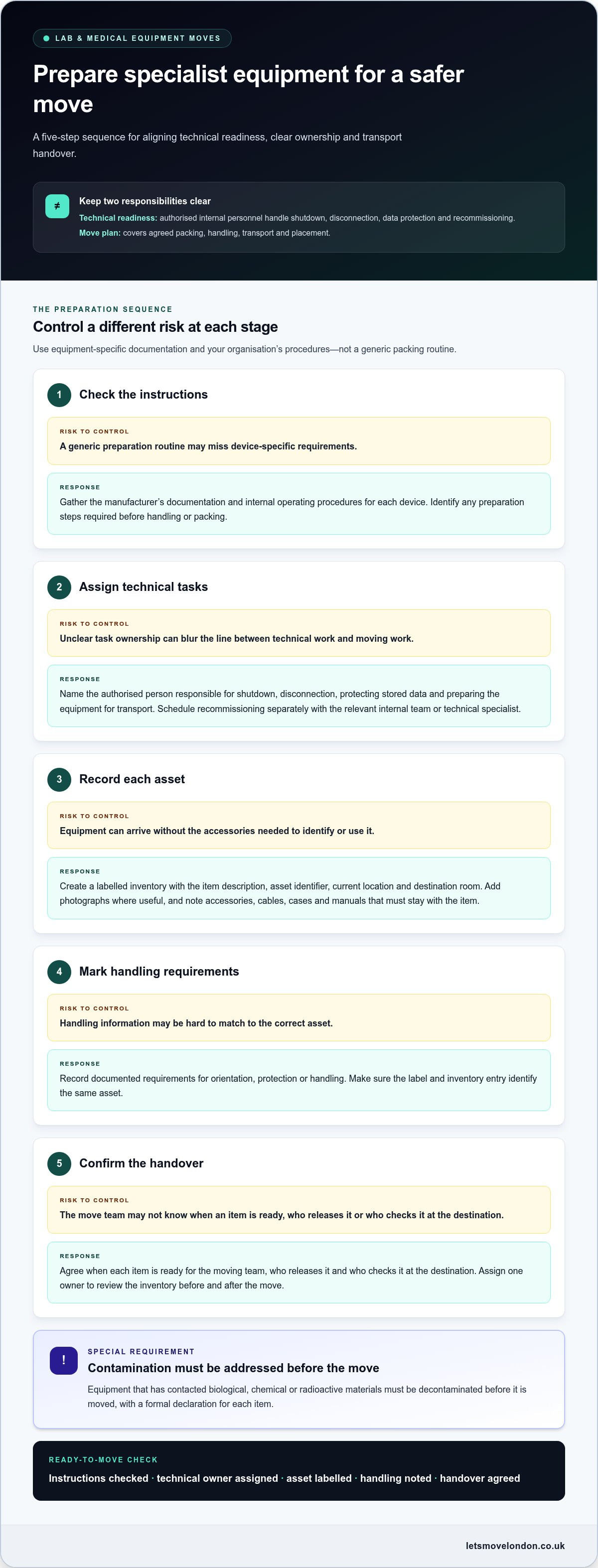
Preparation should follow each item’s documented requirements, not a generic packing routine. Manufacturer guidance and your organisation’s procedures take precedence. Separate technical readiness from transport packing so responsibilities are clear: authorised internal personnel handle shutdown, disconnection, data protection and recommissioning, while the moving plan covers agreed packing, handling, transport and placement.
Use this sequence to prepare assets for an office relocation canary wharf move:
1. Check the instructions. Gather manufacturer documentation and internal operating procedures for each device. Identify preparation steps that must happen before it can be handled or packed.
2. Assign technical tasks. Name the authorised person responsible for shutdown, disconnection, protecting stored data and preparing the equipment for transport. Schedule recommissioning separately with the relevant internal team or technical specialist.
3. Record each asset. Create a labelled inventory with the item description, asset identifier, current location and destination room. Add photographs where useful, and note accessories, cables, cases and manuals that must stay with the item.
4. Mark handling requirements. Record the manufacturer’s or technical team’s instructions, including any documented requirements for orientation, protection or handling. Make sure the label and inventory entry identify the same asset.
5. Confirm the handover. Agree when an item is ready for the moving team, who releases it and who checks it at the destination. Assign one owner to review the inventory before and after the move.
A well-labelled inventory prevents a common source of confusion: equipment arriving without the accessories needed to identify or use it. For example, if a workstation and its labelled cables are assigned to a destination room, the receiving team can match them without relying on memory. Keep the working inventory available to the move coordinator and responsible internal contacts, and record changes promptly.
Transport packing is not the same as technical preparation. Professional packing can be planned around documented handling requirements, with the packing scope and handover point agreed in advance. Don’t ask movers to disconnect or shut down devices unless that technical responsibility has been assigned to authorised personnel. Calibration, installation and recommissioning need their own owners and schedule.
Set aside hazardous, regulated or contamination-sensitive materials for separate internal procedures. Equipment that has contacted biological, chemical or radioactive materials must be decontaminated before it is moved, and a formal decontamination declaration is required for each item. Identify these assets early and coordinate the necessary preparation and records through the organisation’s responsible personnel.
Clear labels, named owners and a recorded handover give everyone a practical reference at each stage. Let’s Move London provides commercial moving, professional packing and secure storage across London. Explore relocation support for a move planned around your agreed packing scope and operational priorities.
Choose a Canary Wharf Move Plan That Balances Equipment and Downtime
The move sequence affects more than the order in which items leave the building. It can shape staff availability, access to essential equipment and when connected teams can resume work. For an office relocation canary wharf project, compare approaches against operational priorities and the access windows available at both sites. No format guarantees a particular downtime outcome, but careful sequencing makes the trade-offs visible before move day.
Move sequencing should follow business dependencies, so each team and asset is relocated in an order that supports the work that must continue. Use this comparison as a starting point:
Phased move: Relocate selected teams or assets in stages. This can suit departments that can operate separately, but requires coordination across phases and clear temporary arrangements.
Department-by-department move: Move a complete team and its related contents together. This can make ownership and destination placement easier to track, provided departments do not rely on equipment or systems that are still at the old site.
Consolidated move: Relocate most contents within one planned period. This can reduce the number of separate handovers, but requires readiness across teams, destination rooms and building access arrangements.
Map dependencies before choosing. For example, if a team needs a particular device and a connected workstation to resume work, plan those assets as a linked group alongside the staff and room they depend on. Rank items by operational importance, not simply by size or value. Identify which functions can pause, which need temporary arrangements and who approves each stage. Keep the sequence flexible enough to account for building access windows and changing priorities.
When does a phased office move make sense?
Phasing may suit an organisation whose departments can relocate at different times without interrupting essential workflows. First map links between equipment, staff, rooms and connected systems. Then define what remains operational during each phase, where affected staff will work and who owns each handover. Staging is not automatically faster or less disruptive: repeated access bookings, overlapping work and split teams can add coordination demands.
How should you assess commercial relocation support?
Look for a clear planning process, communication plan, packing scope and move-day coordination. A tailored commercial relocation plan should set out what the moving team will handle, distinguish that work from technical equipment services, and reflect building access and business priorities. Let’s Move London coordinates commercial relocations across London, with professional packing and secure storage available to support practical project requirements.
Before settling on an approach, review the sequence with the people responsible for operations, facilities and technical preparation. Confirm what must be ready at the destination before each group of items arrives, and identify decision-makers who can respond if priorities change. This shared view helps teams prepare without assuming one move format suits every organisation.
Coordinate Canary Wharf Building Access, Loading and Move-Day Logistics
In Canary Wharf, access arrangements need to be confirmed for the exact origin and destination buildings. Procedures can differ between properties, so don’t assume that a booking, loading route or security process at one site will apply at another. Confirm requirements with each building’s management team and build them into the move schedule.
Arrange the practical details before move day, including:
Loading access: Confirm the designated area, booking process, permitted access hours and delivery window with the building contact.
Service lifts and routes: Check lift dimensions and the full route to each workplace against the dimensions of larger equipment. Consider doors, corridors and turns as well as the lift itself.
Security procedures: Prepare any required visitor or contractor details, passes and sign-in information through the relevant building process.
Vehicle positioning: Agree where the moving vehicle may wait or load, and how the crew should reach the building from that point.
Recheck these arrangements close to the move date. A change to a loading slot, lift booking or building procedure can affect the sequence for moving equipment and other office contents. Keep written confirmations with the project brief, and share updates promptly with the move lead and the people responsible for each site.
For a specialist-equipment move, access planning should reflect the agreed item sequence. A large asset may need a particular route or room prepared before delivery, while a lift booking may determine the order in which teams can receive items. Check those dependencies with building contacts and internal staff rather than relying on assumptions about the estate.
Choose one move-day lead as the central point of coordination between your business, the building teams and the removal crew. Give them the final asset inventory, floor plan and destination-room labels. Make sure essential business contacts can be reached during loading, transit and placement, especially if a room or delivery sequence needs a decision. Record exceptions or condition concerns through your organisation’s agreed handover process.
A short move-day briefing can confirm who is present at each site, the order of work, building access arrangements and how changes will be communicated. Keep the agreed schedule available to the people coordinating the move. The London removals planning guide can also help with wider preparation for a move in the capital.
Share your locations, preferred dates, asset overview and known building constraints to shape a tailored commercial relocation plan with Let’s Move London. The plan can bring access requirements and move-day arrangements together in one clear schedule.
Arrange a Tailored Lab or Medical Equipment Relocation in Canary Wharf
A well-scoped office relocation canary wharf project brings four things together: the asset inventory, building access arrangements, agreed packing scope and the organisation’s operational priorities. Sharing these details early helps shape a practical commercial move plan and clarifies which tasks belong to the business, its technical staff and the moving team.
What information helps shape a relocation plan?
Prepare the origin and destination addresses, preferred dates and an overview of the equipment and general office contents. Include room plans where available, plus building contacts and known access constraints. For sensitive assets, share handling requirements documented by the manufacturer or your internal technical specialists. This gives the project team useful context without replacing your organisation’s technical procedures.
It also helps to state what support you need with packing and whether storage should form part of the move. A clear outline can distinguish equipment that needs planned protective packing from routine office contents, while showing which items depend on specific room access or delivery arrangements.
Locations and timing: Provide both addresses and your preferred move dates.
Scope: Summarise equipment, furniture and other office contents, noting any particularly fragile, bulky or high-value items.
Site details: Share relevant room plans, building access information and known constraints.
Project needs: Describe the packing scope, storage requirements and operational priorities.
What happens after the move scope is defined?
The agreed scope provides a basis for planning the schedule, packing arrangements and site coordination. Responsibilities should be clear: your organisation oversees operational decisions and internal preparation, technical staff manage equipment-specific procedures, and the moving team carries out the agreed relocation work. Project details shape the tailored commercial quote, so a practical overview helps establish a relevant plan.
Let’s Move London provides commercial relocation, professional packing and secure storage across London. Each project is organised around its agreed contents, locations and practical requirements, with coordination between the business and the moving team. This keeps the plan focused on the work being relocated, rather than assuming every office or asset follows the same process.
Before making an enquiry, gather the locations, preferred dates, asset and office-content overview, building constraints, and any packing or storage needs. Add relevant documented handling instructions and note who will manage technical preparation within your organisation. These details help establish the move scope and clarify responsibilities from the outset.
Share your project details with Let’s Move London and request a tailored commercial relocation quote for your Canary Wharf move.
Set Your Canary Wharf Move in Motion
Your next step is to turn the move requirements into a project brief that gives everyone a shared starting point. For an office relocation canary wharf project, outline the locations, preferred timing, assets involved, building constraints and operational priorities. This focuses planning on your actual requirements rather than a generic office move.
Let’s Move London provides commercial relocation services across London, with professional packing and secure storage to support business moves. Share the scope you have so far, even if some details are still being finalised. A clear brief helps establish the practical moving arrangements, the packing or storage required, and the responsibilities your organisation will manage internally.
Bring your site details and key priorities together, then request a tailored commercial relocation quote. With a considered plan in place, your team can move forward with greater clarity and focus on preparing for the next stage of work.
Frequently Asked Questions
How do you move laboratory equipment to a new office?
Move laboratory equipment by coordinating its documented preparation, packing, transport and arrival checks. Start by confirming which items can travel together and which depend on room readiness or connected systems. For example, keep an instrument’s accessories and manuals identifiable with the instrument, then compare its condition and inventory record on arrival. If equipment has contacted biological, chemical or radioactive materials, arrange the required decontamination and item-specific declaration before the move.
Can medical equipment be moved without disrupting business operations?
A move can be planned to reduce avoidable disruption, but uninterrupted operations can’t be guaranteed. Identify essential services and the equipment they depend on, then discuss temporary arrangements, staff cover and the relocation order with operational leads. For an office relocation canary wharf project, include building access windows in that discussion. Keep a clear decision-maker available if site access or operational priorities change.
What should be included in a medical equipment relocation plan?
Include an accountable project lead, an agreed schedule, equipment records, site arrangements and a clear division of responsibilities. Add approval points for technical readiness and destination acceptance, so equipment isn’t treated as ready for use simply because it has arrived. For sensitive items, record who can access related records or data during the transition. Set out how delays, missing accessories or condition concerns will be escalated and documented.
How do you prepare sensitive equipment for transport?
Follow the equipment manufacturer’s instructions and your organisation’s procedures, and have authorised personnel complete technical preparation. Keep removable parts and accessories identified with their asset, and use packing suited to its documented handling needs. Before moving equipment exposed to biological, chemical or radioactive materials, arrange decontamination and a formal declaration for each item. Treat contaminated equipment or items containing hazardous materials as a separate internal handling matter, not routine office contents.
How far ahead should a Canary Wharf office move be planned?
Allow three to six months for planning a medium-sized Canary Wharf office move. A larger organisation, particularly one with complex IT systems or dependencies between departments, should allow a longer planning period. Start earlier if the project needs multiple building arrangements, technical preparation or a staged sequence. The time available affects how readily teams can coordinate access, prepare assets and agree continuity arrangements before moving day.
Does an office removal service include reconnecting or calibrating medical equipment?
Reconnection and calibration are technical tasks, not something to assume is part of ordinary removal work. Assign them to authorised internal personnel or the relevant technical specialist, and schedule them around delivery and room readiness. Make the division of work explicit in the project scope: the moving team handles agreed relocation tasks, while technical staff manage device-specific shutdown, reconnection, testing and approval for use.
What information do I need to request a commercial relocation quote?
Provide the origin and destination addresses, preferred dates and a practical overview of equipment, furniture and other contents. Note unusually large or delicate items, access arrangements at both buildings, and any packing or storage requirements. Include the best project contact and known operational constraints, such as rooms that must be ready before delivery. These details help Let’s Move London shape a commercial relocation quote around your project scope.



Comments