
Moving Vans in London: How to Choose and Book One
The right moving van for a London move depends on how much you are shifting, how tight your access is and whether you want a driver and helpers included. For most one or two bedroom flats a large van with movers is usually enough, while a full house or an office often needs a Luton van or several trips. We will walk through sizes, costs, booking times, licences and the London-specific hurdles that catch people out.
Which Size of Moving Van Do You Need?
The right size is the smallest van that carries your whole move in one trip, because a second trip costs time and money in a city where every hour counts. Here is a rough guide to what each size usually handles.
Van type | Typical use |
Small van | A few boxes, a bike, one or two items of furniture |
Medium or large panel van | Studio or one-bedroom flat |
Long wheelbase or extra-high van | One to two bedroom flat with a sofa and bed |
Luton van (box van with a roof overhang) | Two to three bedroom home or a small office |
7.5 tonne lorry | Large houses and bigger offices |
If you are unsure, go up a size rather than down. A van that is too small means a second run through London traffic, and that rarely saves anything. Our Luton van size guide gives dimensions and capacity in more detail, and the moving van overview covers the basics if you are new to all this.
Think about access, not just volume
London access can matter more than the number of boxes. A Luton van is tall and long, so check for low railway bridges, narrow mews and tight turning circles near your address. If your street is cramped, a smaller van making two runs may be easier than a large one that cannot get close. Flat moves with long carries are worth planning around, and our guide to moving into a flat with no lift shows how to prepare for stairs.
What Is the Difference Between Hiring a Van and Booking a Man and Van?
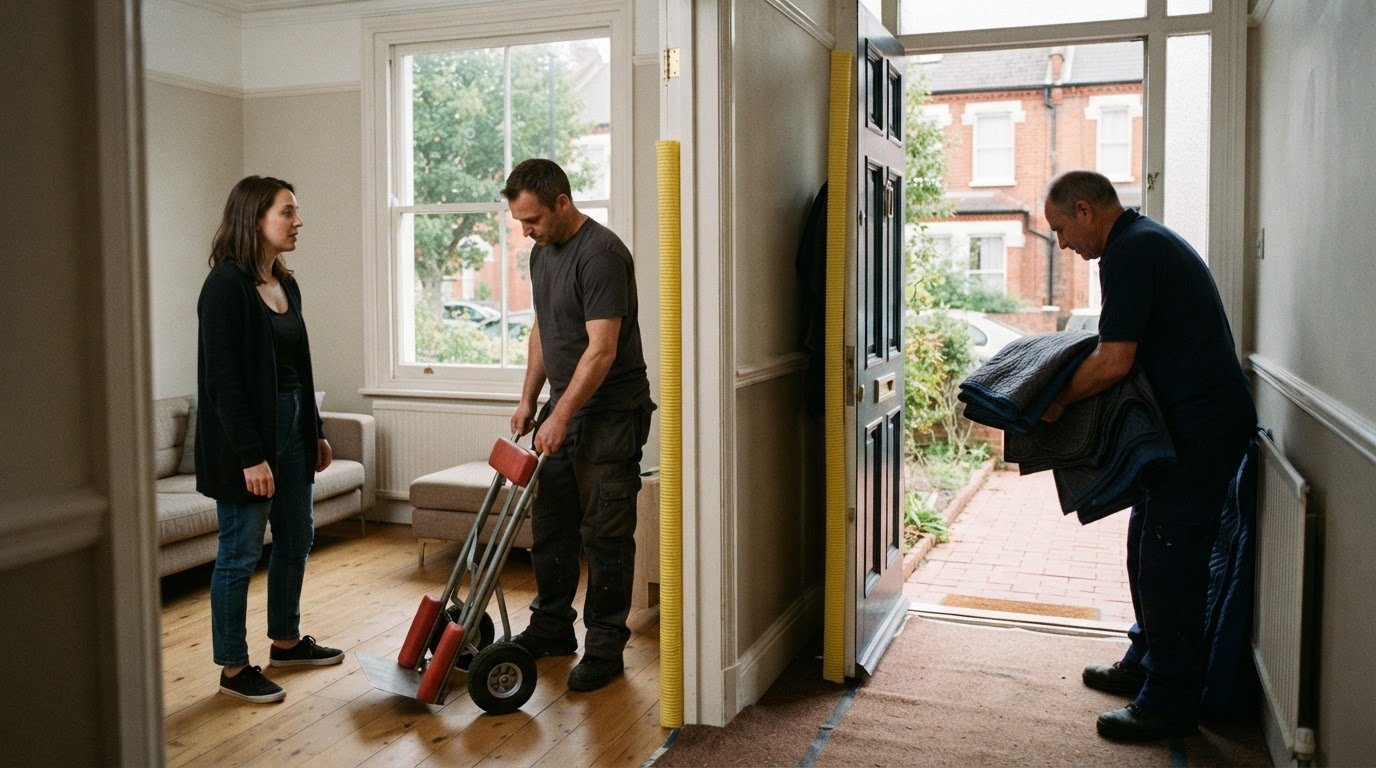
Self-drive hire means you collect the van, load it, drive it and return it, while a man and van service sends a driver and helpers who do the heavy lifting for you. Self-drive can look cheaper on paper, but you carry the risk of damage, the fuel, the parking and a long day of lifting.
A few points to weigh up:
Self-drive hire suits small moves with a friend or two to help and someone confident driving a large vehicle in central London.
Man and van suits flat moves where stairs, awkward furniture and parking are the real challenge.
Full removals suit larger homes or anyone who wants packing, dismantling and reassembly handled too.
If you would rather hand the whole job over, a full house removals style service takes the lifting, loading and driving off your plate. Lets move london offers House removals for flats and houses, including packing, transport, reassembly and optional storage, which is handy when your move-out and move-in dates do not line up.
Can a 22 Year Old Drive a Rental Van?
Yes, in many cases a 22 year old can drive a rental van, but the rules vary by hire company, and some set minimum ages of 23 or 25 or charge a young driver fee. Your licence is the other half of the question.
According to GOV.UK, a standard car driving licence covers vans up to 3,500 kg, and zero-emission electric or hydrogen vans are covered up to 4,250 kg. A Luton van usually sits inside the 3,500 kg limit, but a 7.5 tonne lorry needs a different licence category. Check the van's maximum loaded weight before you book, and ask the hire company about age rules, excess and insurance at the same time.
Remember that the loaded weight includes the vehicle, driver and passengers, fuel and your belongings. The same GOV.UK guidance says that exceeding the permitted axle weight can bring a fine of up to £300 or a court summons. Heavy items like bookcases, tools and filing cabinets add up quickly.
How Much Do Moving Vans Cost in London?
Prices for moving vans in London vary widely with van size, crew, distance, day of the week and how much help you need, so be wary of any single figure quoted without context. A short flat move with two movers and a van will cost far less than a full house move with packing and storage.
What typically changes the price:
Hourly or fixed pricing, and whether there is a minimum number of hours
The number of movers, and whether you need extra helpers for stairs
Distance and travel time, including time in traffic
Packing, dismantling and reassembly
Parking, Congestion Charge and any suspension costs
Insurance, which some firms charge for separately
For a wider look at what a London move can cost, our moving costs guide for London breaks the numbers down, and the article on comparing house moving quotations helps you read quotes side by side. With Lets move london, every move includes insurance as standard with no extra charge, and there are no hidden fees for furniture assembly, disassembly or packing.
How Far in Advance Should You Book a Moving Van?
Book as early as you know your date, ideally four to six weeks ahead, and earlier still for Fridays, month-ends and school holidays. Popular days fill up first.
The data backs this up. In 2025, Friday was the most popular moving day, and the median moving distance was 10 miles, according to Property Industry Eye. Peak days are also unpredictable: around 24,700 home moves took place on Halloween that year, far above the daily average.
If your completion date is fixed, book the moving van early and ask how the firm handles delays. If you can be flexible, a midweek move often means more choice and calmer roads.
A simple booking timeline
Six weeks before: get quotes and confirm your date.
Four weeks before: book the van and crew, and arrange parking permissions.
Two weeks before: confirm access details and any storage needs.
One week before: reconfirm the booking and final inventory.
Day before: pack essentials separately and defrost the freezer.
How Do You Deal With Parking, Permits and the Congestion Charge?
You deal with parking by sorting permissions before moving day, because a van that cannot stop near your door slows the whole move and can attract fines. London adds a few layers: resident bays, red routes and the Congestion Charge.
Practical steps:
Check your council's rules. Some boroughs let you reserve a bay or suspend parking for a fee. If you are moving into a new borough, the Royal Borough of Kensington and Chelsea says people moving in can apply for a resident permit up to a week before their move.
Know the Congestion Charge.TfL's payment guide explains when and how to pay, the late-payment deadlines and the discounts available.
Avoid red routes. Stopping to load on a red route can bring a penalty, so read our advice on navigating red routes on moving day.
Speed matters too. According to GOV.UK, the limit in built-up areas is 30 mph, and on single carriageways it is 50 mph for vans and 60 mph for car-type vans. Most London roads are slower anyway, so allow generous journey times.
What Should You Check Before You Book a Moving Van Company?
Check insurance, access planning, a written quote and genuine reviews before you commit. A cheap price means little if the firm turns up without cover or cannot work out how to get your sofa down a spiral staircase.
A short checklist:
Insurance. Is goods-in-transit cover included, or an extra?
A home survey. Lets move london offers a home survey before a house or office move, which helps you get an accurate quote to compare properly.
Written terms. Hourly rate, minimum hours, extra mover charges and cancellation policy.
Experience. Lets move london was founded in 2013 and has safely relocated hundreds of pianos, a good sign when you have bulky or delicate items.
Reviews. Look at recent feedback. On Checkatrade, one review describes two movers completing a move in just over four hours, and another a 2-bedroom flat packed, moved and unpacked in just over two hours.
Storage. If you need it, ask whether it is secure. Ask Lets move london about how its storage is secured and monitored.
For more on choosing a team, see our pieces on packing and moving companies and finding moving companies near you.
What Do House Removals Not Take?
Removal firms generally will not take hazardous or restricted items, and that includes paint, gas bottles, flammable goods, animals and plants. Cash, jewellery and important documents are also best carried by you.
Plan for these before the day:
Hazardous goods: paint, solvents, gas bottles, fireworks and cleaning chemicals
Living things: pets and houseplants, which need their own transport
High-value or irreplaceable items: passports, deeds, jewellery, laptops
Perishables: open food and anything that could spoil or leak
Anyone sorting out older plumbing before handing over keys might also look at drain maintenance specialists such as Revives AB for avloppsunderhåll, though check they cover your area first.
How Do You Make a Business Move Less Disruptive?
For an office, the key is to move outside working hours and to plan the van schedule around your IT, furniture and archive, not the other way round. Even a small team can lose a day if desks, screens and filing arrive in the wrong order.
A few habits help:
Label every crate by desk or department, not just by room.
Move servers, phones and broadband in stages so the team can work from day one.
Book the van for early morning or evening to avoid peak traffic and building restrictions.
Check the lift booking and loading bay rules at both buildings.
Keep a clear sign-off list so nothing is left behind.
FAQ
How much is a moving service in the UK?
Costs depend on distance, home size, number of movers and extras like packing or storage. A small flat move is far cheaper than a full house relocation, so ask for a written quote based on a survey rather than a guess.
Do I need to be present when the van arrives?
Yes, or someone you trust should be. You will need to confirm access, point out fragile items, sign off the inventory and hand over keys, so it is not a job to leave unattended.
Your next step is simple: make a rough inventory of what you are moving, note any stairs, narrow doors or parking limits, and use it to ask for quotes. If you would like a crew to handle the lifting and the planning, House removals from Lets move london cover packing, transport, reassembly and optional storage. We would be glad to look at your home or office first, so get a quote and we will work out the right van and team for your move.


Comments