
Piano Movers Near Me: A Guide to Hiring One in London
If you're searching for piano movers near me in London, look for a team that specialises in pianos, carries proper insurance, and visits your home to check stairs, doorways and parking before quoting. A piano is heavy, awkward and easily damaged, so a general removal crew without the right kit is a risk to the instrument, your walls and their backs.
We know that finding the right people can feel daunting, especially in a city of narrow hallways, tight staircases and busy streets. This guide walks us through what to check, what to ask and how to prepare, so you can book with confidence.
Why Pianos Need Specialist Movers
Pianos need specialist movers because their weight, delicate internal mechanisms and awkward shape make them far harder to handle than ordinary furniture.
A London piano-moving guide from Piano Move Team gives typical weights that put this into perspective:
Piano type | Typical weight |
Cottage upright | 150 to 180 kg |
Standard upright | 180 to 230 kg |
Baby grand | 160 to 260 kg |
Full or concert grand | 250 to 600 kg |
Weight is only part of the picture. Inside the case there are thousands of moving parts, a cast-iron frame under enormous string tension, and a finish that marks easily. A knock to a corner can crack veneer, and a sharp tilt can unseat a leg or strain a pedal lyre.
The HSE is clear that manual-handling law sets no specific weight limits for lifting. Its guidelines are not "safe limits" but a way of identifying lower-risk tasks, according to its manual handling guidance. It also advises avoiding hazardous manual handling where reasonably practicable, assessing the risks that can't be avoided and reducing them as far as you reasonably can. For a piano, that means trained teams, the right equipment and a plan, rather than a few friends and a lot of optimism.
What to Look for in Piano Movers Near Me
The best piano movers in your area are ones who can show relevant experience, include insurance, and offer a survey before they give you a price.
Here's a simple checklist to work through when comparing companies:
Piano-specific experience. Ask how many pianos they move and whether the crew who attend have done it before. Ask every company how many pianos it has moved and how many of its crew have handled them before.
Insurance. Ask exactly what is covered and whether it costs extra. Lets move london includes insurance as standard on every move, with no extra charge for it.
A survey before the quote. A company that quotes without seeing your access is guessing. Lets move london offers a free home survey before every house or office move.
Proper equipment. Look for protective covers, piano trolleys, ramps and straps, plus the ability to remove a window where access is tight.
Clear, written pricing. Check that assembly, disassembly and packing aren't hiding extra fees, and ask how long a quote stays valid. Ask how long a quote stays valid and whether it includes any hidden fees.
If your piano is part of a wider house move, it helps to choose a company that can handle everything in one visit. Our guide to moving companies near me explains how to compare full-service options, and our overview of piano movers in London goes deeper on the specialist side.
How London Access Affects Your Piano Move
London access affects your move more than almost anything else, because a piano that fits in the room it's in may not fit through the doors, corridors and stairs needed to get it out.
Think about the typical Victorian conversion with a steep, narrow stair and a turn at the half-landing. Or a first-floor flat in a mansion block with a small lift. Or a terrace where the front door opens straight onto the pavement with nowhere to pause. Each of these changes how long the job takes and which techniques the crew need.
A piano-moving guide recommends measuring doorways, corridors and staircases at both addresses, and checking lift dimensions and booking requirements with building management. It's good advice, and it's worth doing before you request quotes so you can describe the route accurately.
Measurements worth taking
Door widths at the narrowest point, including any frame or hinge that reduces the opening.
Stair width and headroom, especially where the ceiling drops under a landing.
Turns and landings, noting how much floor space there is to pivot.
Lift internal size and whether it must be booked in advance.
Distance from the front door to where the van can stop.
Photographs help too. Send them with your enquiry so the surveyor can spot issues early. And if access looks truly tight, ask whether window removal is an option. Our piano removals service covers specialist transport with protective covers, trolleys and window removal where access is tight, so it's a good place to start if your route looks challenging.
Parking, Permits and Street Access
Parking is the part of a London piano move that most often catches people off guard, so it's worth sorting early.
A van needs to stop as close to your door as possible. The further a piano has to be wheeled, the greater the risk and the longer the job. If you live on a controlled street, you may need to arrange a parking-bay suspension, and the notice periods vary a lot between boroughs. Notice periods vary by borough, so check with your local council early, as Hold Storage notes they can differ considerably across London.
Because those timeframes differ so much, we'd suggest checking with your local council as soon as you have a moving date. Your movers can often advise on what's needed for your street, and a quick conversation at survey stage can save a stressful morning.
A few practical tips:
Ask neighbours to leave the space in front of your property clear if you've arranged a suspension.
Mention any one-way streets, low bridges or weight restrictions when you enquire.
If you're moving from or to a flat with a shared entrance, let building management know the date and time.
Keep the route clear of bikes, bins and buggies on the day.
Uprights, Grands and Other Piano Types
Different pianos need different handling, and a good mover will plan around yours rather than treating every instrument the same way.
Upright pianos are the most common in London homes. They're tall, top-heavy and usually moved on a trolley with straps, so stairs are the main challenge. Standard uprights sit in the weight range mentioned earlier, which means a trained team of at least two or three is usually needed.
Baby grands and larger grands are a different job entirely. The lid, legs and pedal lyre are typically removed, and the body is tilted onto its side on a special board, wrapped and padded. That takes skill and the right equipment, and it's not a task for amateurs.
Digital pianos are lighter, but they still need care. Keyboard actions, stands and connections are delicate, and the original packaging, if you've kept it, is useful.
Antique or high-value instruments may need extra consideration, such as a specialist assessment or tuning before and after the move. If your piano has sentimental or financial value, mention it when you enquire so the team can plan accordingly.
How to Prepare Before the Movers Arrive
Good preparation makes the day quicker, safer and cheaper, and most of it takes only an hour or two.
The HSE's guidance on good handling technique recommends planning a lift, using suitable handling aids where possible and removing obstructions before handling a load. That applies perfectly to a piano move, and it gives us a useful frame for preparation.
Before moving day
Clear the route. Move rugs, plants, side tables and loose items from the piano to the front door, and check the same at the new home.
Protect the floors and walls. Your movers will bring covers, but removing wall hangings along the route avoids accidents.
Empty the piano. Remove ornaments, music books and photographs from the top, and check inside the stool for stored items.
Secure the lid and keys. Ask your movers whether to lock the keyboard cover, and keep any keys somewhere safe.
Plan the new position. Decide exactly where the piano will go, away from radiators, direct sunlight and damp external walls.
Book your tuner. Pianos usually need tuning a few weeks after a move once they've settled to the new environment.
If you're packing the rest of the house at the same time, our guide to packing and moving companies explains how a combined service works.
Questions to Ask Before You Book
Asking a handful of direct questions will tell you quickly whether a company is the right fit for your piano and your home.
Will you carry out a survey before quoting, and is it free?
Who will actually attend, and have they moved this type of piano before?
What does your insurance cover, and is there an extra charge for it?
Can you remove a window or use other methods if access is tight?
How long is the quote valid, and are there any extra charges for assembly, disassembly or packing?
Where will the piano be stored if there's a gap between collection and delivery, and is the storage monitored?
On that last point, Lets move london's secure storage is monitored by 24/7 CCTV, and there are no hidden fees for furniture assembly, disassembly or packing. If you'd like to compare costs more generally, our breakdown of what movers cost shows what affects the price.
It's also reasonable to ask what happens if something goes wrong. Delays and no-shows are rare with a reputable company, but knowing the process puts your mind at rest. Our guide on what happens if movers are late is a helpful read.
Is a Piano the Only Thing You're Moving?
Most people moving a piano are also moving a home, so it makes sense to think about the whole job rather than the instrument alone.
If you're relocating a flat or house, a single team handling both the piano and your furniture means one survey, one quote and one day. That saves coordination and often reduces the number of times things are carried through tight spaces.
Lets move london's Checkatrade reviews give a sense of the pace of a well-organised move: one describes two movers completing a job in just over four hours, and another a 2-bedroom flat packed, moved and unpacked in just over two hours. Every home is different, of course, so use these as a flavour rather than a promise, and ask for a survey to get a realistic estimate for yours.
A piano on its own is a different matter. If you only need a single item carried with no packing or planning, a specialist single-item service may suit you better than a full removal company. And for anything involving paint, gas bottles, animals, plants or flammable goods, you'll need to make separate arrangements, as these aren't moves Lets move london handles.
Red Flags When Choosing Piano Movers
A few warning signs should make you pause before booking, however convenient or cheap the offer looks.
A quote without any questions. If nobody asks about stairs, floors or access, they haven't thought about the job.
Vague insurance answers. If a company can't explain cover clearly, assume it isn't there.
A price that's far below the rest. Very cheap quotes often mean untrained crews or add-ons later.
No mention of equipment. Pianos need trolleys, covers and straps, not just a van and muscle.
Pressure to pay a large deposit upfront. A fair booking process shouldn't feel rushed.
For anything particularly heavy beyond the piano, our article on heavy furniture movers in London is worth a look too.
What Happens on Moving Day
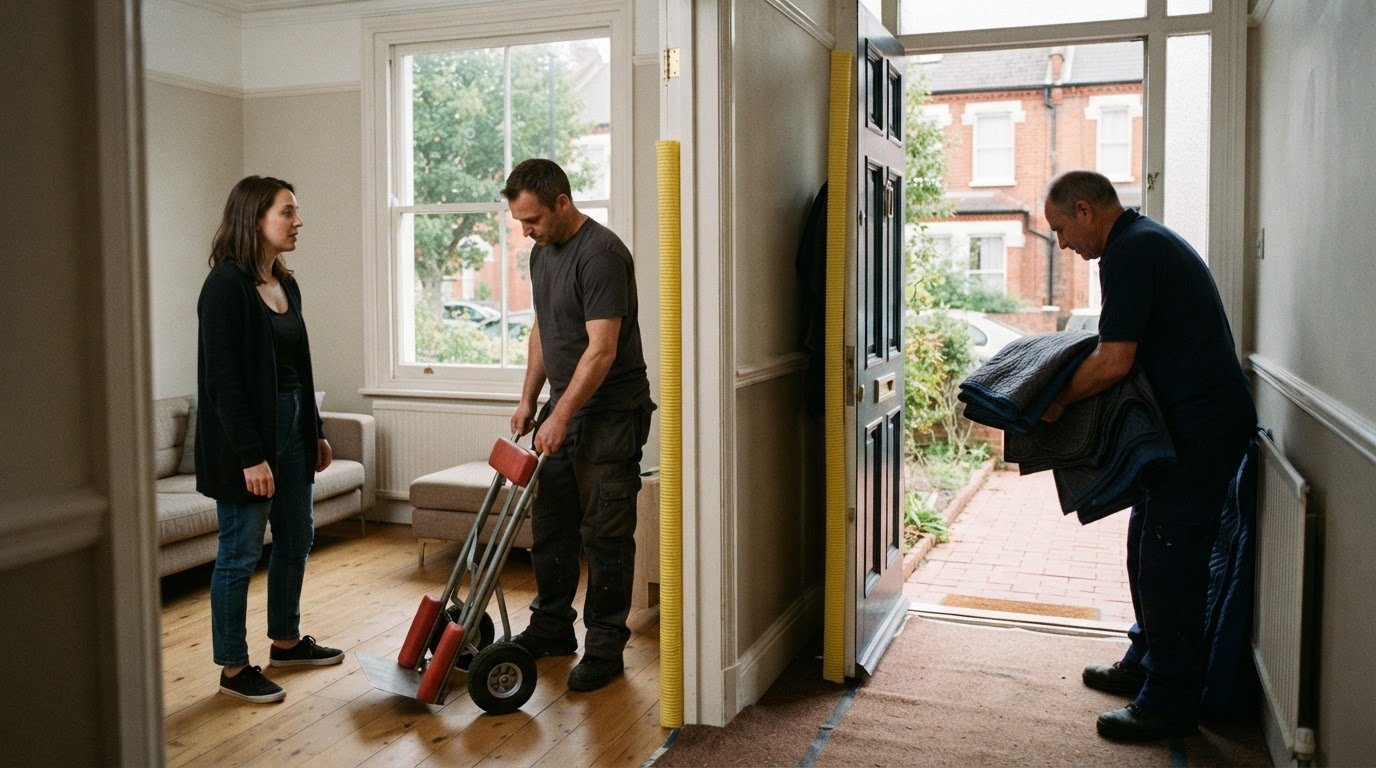
On moving day, a good piano team will walk the route, protect the instrument and your property, and then move it in a calm, deliberate order.
Expect the crew to look at the access once more, lay protective floor covering where needed and wrap the piano in padded covers. They'll strap it to a trolley or board, move it carefully along the route and load it onto the van with the right fixings so it can't shift in transit.
At the new address, the process runs in reverse. The team will bring the piano in, position it where you've chosen and check that it's stable and level. It's a good idea to take a quick look at the instrument together, so any concerns are noted straight away.
Try to be on hand to answer questions, but let the team work. They'll appreciate a clear route, a cup of tea if you're offering, and a decisive "yes, there please" about placement. After that, give your piano a few weeks to settle before booking the tuner, and enjoy playing it in your new home.
Your next step is simple: measure your doorways and stairs, take a few photos of the route, and write down the piano's make and approximate size so you're ready for a survey. From there, our team can look at your access and talk you through the options, including our specialist piano removals service. When you're ready, you can get a quote from Lets move london and we'll take it from there.


Comments