
Getting a Binding Quote for a House Move: Step-by-Step Guide
Updated: Oct 1
What makes a house-move quote dependable: the price, or the details behind it? Getting a binding quote for a house move starts with a complete picture of what’s being moved, where it’s going and the access at both properties. If the items or circumstances differ from the information provided, the amount due may be affected, depending on the terms you agreed.
It’s reasonable to want certainty before booking, especially when quotes use different assumptions or don’t make clear what’s included. A quote labelled “binding” isn’t enough on its own. Read the written terms, check what’s covered and excluded, and ask how changes to your inventory or access could affect the price.
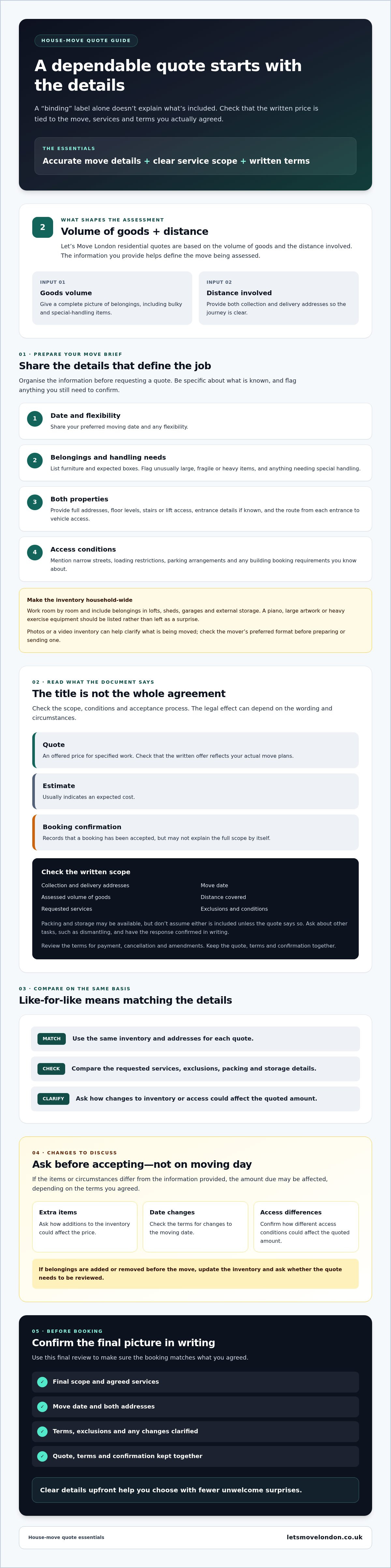
This guide explains what to provide for a clear move assessment, how to compare quotes on a like-for-like basis, and what to confirm before you book. You’ll also learn why an individual assessment matters: residential quotes from Let’s Move London are based on the volume of goods and the distance involved. With the right details agreed upfront, you can choose a moving service that fits your London move with fewer unwelcome surprises.
Table of Contents
What makes a house-move quote binding, and what does it cover?
A written removal quote is a price offer linked to a defined move, the services requested and the terms set out in the document. Its usefulness depends on how clearly it describes the job and whether the details you supplied are accurate. Getting a binding quote for a house move means checking that the written offer reflects your actual plans, rather than relying on the label alone.
An estimate usually indicates an expected cost, while a quote sets out an offered price for specified work. A booking confirmation records that a booking has been accepted, but may not explain the full scope by itself. Read the quote and any terms it refers to. The legal effect can depend on the wording and circumstances, so check current UK guidance if you need advice about a particular agreement.
For a quick explanation of the term “binding moving estimate”, watch this video:
Which details should a written removal quote set out?
Check that the quote identifies the collection and delivery addresses, the move date, the assessed volume of goods and the distance covered. These details connect the offer to the move being planned. If the inventory leaves out a room or bulky furniture, the quoted scope may not match what needs to be moved.
Look for a clear record of the services you requested. Packing and storage may be available, but don’t assume either is included unless the quote says so. If you need another task, such as dismantling, ask whether it’s offered and have the response confirmed in writing. Review the terms for exclusions, payment, cancellation and amendments.
Quote, estimate or booking confirmation: how do they differ?
The document’s title doesn’t tell you everything the company has agreed to provide. Read its scope, conditions and acceptance process, and ask for unclear points to be clarified before you confirm. Check that the booking confirmation matches the agreed move details and services. Keep the quote, terms and confirmation together so you have a clear record of what was accepted.
How to prepare a complete move brief before requesting your quote
A detailed brief helps a mover assess the volume of goods and distance involved, two factors used to calculate residential quotes at Let’s Move London. It also gives you a record of the details behind the offer. Prepare your information in a clear order:
Confirm your dates: Share your preferred moving date and any flexibility.
List your belongings: Include furniture, boxes and items needing special handling. Flag anything unusually large, fragile or heavy.
Describe both properties: Provide the full addresses, floor levels, stairs or lift access, and the route from each entrance to vehicle access.
Explain access conditions: Mention narrow streets, loading restrictions, parking arrangements and any building booking requirements you know about.
A complete inventory helps the mover assess the goods volume and handling needs involved. Photos or a video inventory can clarify what’s being moved, but check the mover’s preferred format before preparing or sending one.
Build an inventory that reflects the whole household
Work through each room and note furniture, expected box counts and items that need special handling. Include belongings in lofts, sheds, garages and external storage. List a piano, large artwork or heavy exercise equipment rather than leaving it as a surprise on moving day. If you add or remove belongings before the move, update the inventory and ask whether the quote needs to be reviewed.
Describe London access and property conditions
For both addresses, record floor levels, stairs, lift availability, entrance details if known, and the distance between the entrance and vehicle access. In London, narrow streets, loading restrictions, parking arrangements and building rules for shared areas can affect how access is managed. Be specific about what you know, and mark anything you still need to confirm.
If you’re unsure whether a local permission or access arrangement is needed, check current guidance from the relevant London borough or your building management. Requirements can vary by location and circumstance, so verify them rather than assuming one rule applies across London. Tell the mover what you’ve confirmed and ask how any unresolved access detail should be recorded in the quote.
For more practical planning support, explore Let’s Move London’s moving advice articles. Share your move details with the company before booking so the assessment can reflect the home and access arrangements involved.
How to compare house-move quotes without overlooking important terms
A fair comparison starts with matching information. If one company has assessed a full inventory and another has only a brief description, their quotes may cover different jobs. Whether evaluating local providers or long distance moving companies, check that each quote uses the same belongings, collection and delivery addresses, moving date and requested services before comparing prices.
Let’s Move London assesses residential fees using the volume of goods and the distance involved. An individual assessment can make the quote more relevant to your move, but you still need to review its written scope. Use a comparison table to identify gaps and assumptions:
Check inclusions, exclusions and assumptions side by side
Don’t assume a service is included because it came up in a conversation. Check whether packing, storage and other requested services are clearly recorded. If you need dismantling, ask whether it’s offered and have the answer confirmed in writing. Review access and schedule assumptions too. For example, a quote based on straightforward loading may not reflect stairs, restricted parking or a long route from the property to the vehicle.
Ask the company to explain unclear wording before you accept. A lower headline figure may reflect a narrower scope, so compare the work and terms rather than treating different offers as equivalent. Reputable relocation specialists like Atlas International Movers & Cargo Shipping emphasize that transparent breakdowns of packing, transit, and handling are essential for an accurate evaluation.
Use a like-for-like comparison before choosing
Separate confirmed services from optional or unconfirmed requests. If one quote includes storage and another doesn’t, mark that difference clearly. Check that each company has the same inventory and both addresses, and request an updated written quote if an assumption needs correcting.
For further London planning context, browse Let’s Move London’s London moving advice. Before choosing, make sure you understand each quote’s scope, exclusions and change terms, then share any unanswered questions with the relevant company.
Can a house-move quote change? Understand revisions before you accept
It can, but the answer depends on the written scope and the terms you agreed. A change to your plans doesn’t automatically mean the price will change. Tell the mover promptly and ask how the change will be handled under its stated process. Getting a binding quote for a house move means checking those change terms before you accept, rather than assuming every possible variation is covered.
A quote reflects the information used to prepare it. If the move details change, the original document may no longer describe the job accurately. Ask the provider whether the change affects the scope or quoted amount, and request any revised terms in writing before relying on them.
What changes should you disclose before moving day?
Tell the mover as soon as you can if you add or remove belongings, change either address or the moving date, or request a different service. Also update them about access changes, such as a lift becoming unavailable, new parking arrangements or building restrictions that affect loading. These details may be relevant to the agreed scope, but the provider’s terms determine whether they require a revised quote.
Keep a clear record of what you reported, when you reported it and the company’s response. If the mover issues updated paperwork, compare it with the previous version so you can see what changed. Don’t rely on an informal conversation to clarify a revised scope.
What to do when a quote contains unclear conditions
Before accepting, ask what circumstances could lead to a review and how the company will tell you about any proposed changes. Request clear answers on amendments, cancellation and payment terms. If a condition is broad or ambiguous, ask for an example linked to your move, such as how an extra item or a changed collection address would be assessed.
Give the mover time to respond before confirming the booking. Keep the quote, any revisions and related messages together, and check that the final version reflects the details you’ve agreed. This gives both sides a clear reference point if plans change.
For wider planning context, read this London removals guide. If you’re arranging a move, share your updated move details with Let’s Move London so the scope can be discussed before booking.
How to accept your house-move quote and prepare for booking
Before you confirm, make sure the final quote matches the move you intend to make. A careful check can prevent confusion later, especially if your inventory or arrangements have changed since the quote was prepared. When getting a binding quote for a house move, treat the written scope and terms as your reference point and resolve uncertainties before accepting.
Your final checks before confirming the move
The inventory: Does it reflect the belongings you now intend to move?
Both addresses: Are the collection and delivery details correct?
The moving date: Is the confirmed date the one you agreed?
Requested services: Are agreed services, such as packing or storage, clearly stated?
Access arrangements: Are relevant details, such as stairs, lift access or loading arrangements, recorded?
If anything is missing or unclear, ask the company to clarify it before you accept. Follow the stated acceptance process and keep the quote, applicable terms and written updates together. Once accepted, retain the confirmation and refer to it if you need to check what was agreed.
Request a quote with the details movers need
Prepare a room-by-room inventory, your preferred date, and full collection and delivery addresses. Add access information for both properties, including floor levels, stairs or lift availability, and any known building or loading arrangements. Note whether you’re interested in packing or storage so the provider can confirm what’s available and how it would be reflected in the quote.
Let’s Move London provides residential moves with a dedicated moving team and specialised vehicles. Its residential quotes are based on an assessment of goods volume and move distance, so accurate move details are useful when the company prepares a quote. For further planning context, explore this London removals guide.
Have your inventory and property details ready? Request a house-move quote and share the information needed to discuss your move.
Make your next move with a clear plan
Getting a binding quote for a house move is about more than finding a price. Give the mover a complete brief, compare quotes against the same inventory and services, and check the written terms for exclusions and possible changes. Before accepting, confirm the date, addresses, belongings and arrangements the quote covers.
Let’s Move London assesses residential fees using goods volume and move distance. Residential moves include a dedicated moving team and specialised vehicles, with service across Greater London and surrounding counties. Check the specific terms of your quote before booking, as its wording and conditions matter.
Prepare your move details, then request a house-move quote from Let’s Move London. A well-prepared brief gives you a clearer starting point and helps you move forward with greater confidence.
Frequently Asked Questions
What makes a house-move quote binding?
A quote’s effect depends on its written wording, the move details it covers and the terms you accept. Check that it identifies the addresses, date, inventory, services and any conditions that could affect the agreed price. Don’t rely on the label “binding” alone. If you need certainty about the legal effect of a particular document in the UK, seek current guidance or advice relevant to your circumstances.
Can a removal company change its quote after a survey?
A survey doesn’t necessarily prevent a quote being revised. The written scope and agreed terms determine how changes are handled. For example, extra belongings, a new moving date or different access arrangements may mean the original assessment no longer reflects the move. This doesn’t automatically mean the price will change. Ask the company to explain its process and confirm any proposed revision in writing before proceeding.
What information do I need to get an accurate house-move quote?
Provide your preferred date, collection and delivery addresses, and a room-by-room inventory that includes lofts, garages and stored items. Describe access at both properties, including stairs, lifts, parking and the distance to vehicle access. Flag unusually large, fragile or heavy belongings, and note any packing or storage needs. Getting a binding quote for a house move starts with a complete brief that reflects the move you plan to make.
Is a removal quote the same as an estimate?
No, the terms generally signal different levels of certainty, but the label alone doesn’t establish what the company has agreed. An estimate usually indicates an expected cost, while a quote sets out a price offer for described work. Read the document for its scope, conditions and acceptance process. Check the written terms before relying on the price, since the wording and circumstances matter.
Should a house-move quote include packing and storage?
Only if you need those services, and the quote should make clear whether they’re included, separately priced or not part of the offer. Don’t assume packing or storage is covered just because you discussed it. Ask for the relevant service and terms to be recorded in writing. Let’s Move London offers packing and storage, but confirm the specific arrangements for your move before accepting a quote.
How do I compare house-move quotes fairly?
Compare offers based on the same inventory, addresses, date and requested services. Check each document for exclusions and assumptions about access, packing, storage and changes to the move. If one quote covers a service another omits, note that difference rather than comparing headline prices alone. For London moves, make sure each company has accurate details about both properties and the belongings being assessed.
What should I do if my move details change after accepting a quote?
Tell the removal company promptly and in writing if your inventory, date, addresses, access arrangements or requested services change. Ask whether the update affects the agreed scope or quote, and request any revised terms in writing. A change doesn’t automatically mean the price will change; follow the company’s stated process. Keep the original quote, updates and booking confirmation together for reference.



Comments