
Presenting a Moving Budget to Your Boss: 2026 Guide
What if the most successful part of your 2026 business plan was not a new product launch, but a perfectly executed office relocation? Most professionals dread the specific task of presenting a moving budget to your boss because they fear hidden costs or operational chaos. You likely feel the pressure to choose the cheapest option while knowing that an unreliable service could lead to days of lost productivity and damaged equipment. It is a difficult balance to strike when the company's bottom line and your professional reputation are at stake.
This guide provides the framework to master your pitch and secure a "yes" on your first attempt. You will learn how to align relocation costs with business continuity and long-term ROI. We show you how to move away from defensive cost-cutting and toward a strategy that prioritizes reliability and fixed-quote certainty. By the end of this article, you will have the tools to manage this complex project with confidence. You can ensure your London office moves without a single hour of unnecessary downtime while gaining recognition for your efficient project management.
Table of Contents
The Strategic Foundation: Aligning the Move with Business Goals
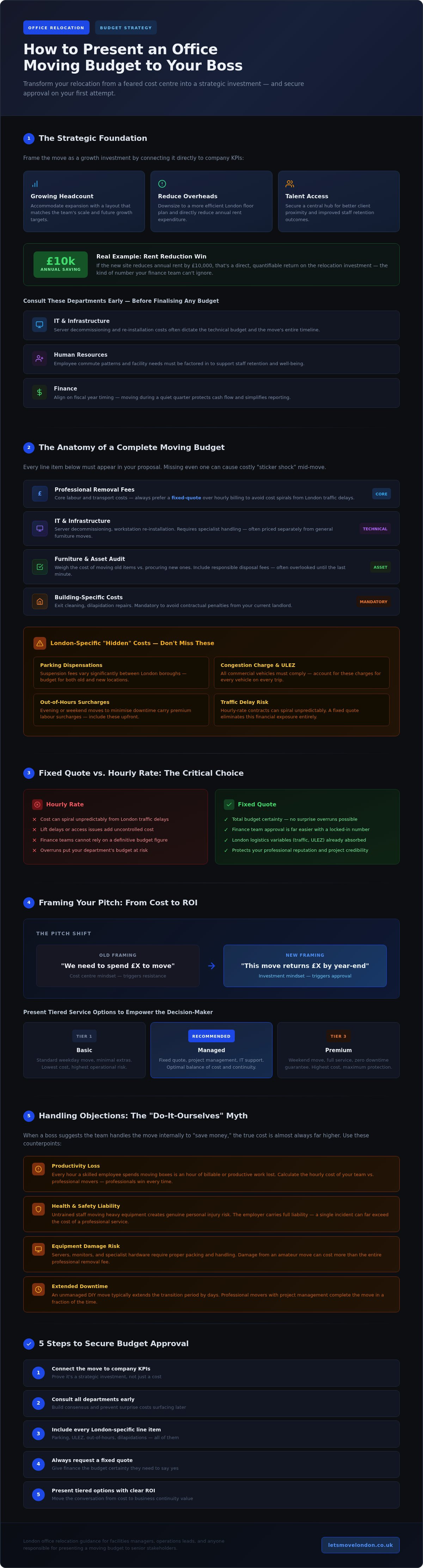
Successful relocations start long before the first crate is packed. When you begin the process of presenting a moving budget to your boss, you must frame the expenditure as a strategic investment. Bosses often see moving as a distraction or a drain on resources. You must prove it's a tool for growth. Start by identifying the primary driver for the change. Are you moving to accommodate a growing headcount? Is the goal to reduce overheads by downsizing to a more efficient London floor plan? Or perhaps the move aims to secure better talent access in a central hub.
Connect the relocation directly to company KPIs. If the new site reduces the annual rent by £10,000, that's a direct win for the bottom line. If it places the team closer to key clients, it's a win for business development. Establishing a "Business Continuity" mindset from your first draft shows you've considered the risks. It demonstrates that you aren't just moving desks; you're protecting the company's ability to function during the transition. For more insights on commercial transitions, check our latest updates on the Let's Move London blog.
Defining the Move’s Value Proposition
Quantify how the new location serves the company's 2026 strategic plan. If the new layout encourages collaboration, link this to project turnaround times or employee engagement scores. Audit your current operational pain points. If your current site suffers from poor connectivity or inadequate meeting spaces, document these as barriers to revenue. Prepare a brief executive summary. This summary should outline the purpose of the move and the expected ROI. It makes the decision-making process easier for stakeholders who focus on the "big picture" and long-term financial health.
Identifying Key Internal Stakeholders
A comprehensive budget requires early input from department heads. This prevents hidden costs from surfacing later and ensures every technical requirement is accounted for in the initial proposal. Consult these departments early:
IT and Infrastructure: Consult IT regarding server decommissioning and re-installation. Their needs often dictate the technical budget and the move's timeline.
Human Resources: Gather feedback on employee commute patterns and facility needs. This ensures the move supports staff retention and general well-being.
Finance: Align with Finance on fiscal year timing. Moving during a quiet quarter protects cash flow and simplifies reporting.
Gathering these perspectives early builds internal consensus. It turns the move into a collective company goal rather than a solo project. This collaborative approach provides the professional weight needed to secure budget approval on your first attempt.
The Anatomy of a Comprehensive Office Moving Budget
Creating a bulletproof list of line items is essential when presenting a moving budget to your boss. It prevents the sudden "sticker shock" that often occurs mid-move when overlooked costs surface. Your budget must start with professional removal fees. While some firms offer hourly rates, a fixed-quote model provides the highest level of financial certainty. Hourly billing can quickly spiral if the team encounters heavy London traffic or unexpected lift delays. A fixed fee allows you to lock in the cost and protect your department's bottom line.
Don't overlook IT and infrastructure. This category includes the decommissioning of servers and the re-installation of workstations at the new site. These technical tasks require precision and often carry separate fees from general furniture moving. You should also audit your furniture and assets. Decide whether it's more cost-effective to pay for the disposal of old items or to procure new pieces for the new layout. Environmentally responsible disposal often carries a specific fee that must be included in your initial draft. Building-specific costs, such as professional exit cleaning and dilapidation repairs, are also mandatory to avoid contractual penalties from your current landlord.
The "Hidden" London Logistics Costs
London moves involve unique overheads that many generic guides ignore. You must factor in parking dispensations and suspension fees for both your old and new locations. These costs vary significantly between boroughs. Account for the Congestion Charge and ULEZ requirements for all commercial vehicles involved in the transition. If your strategy involves minimizing weekday downtime, you'll need to include out-of-hours surcharges for evening or weekend work. Requesting a fixed-quote commercial removal estimate early helps you account for these regional variables with total accuracy.
Contingency Planning and Insurance
Set a realistic contingency fund of 10-15% of the total estimate. This buffer covers unforeseen delays or minor equipment replacements that occur during complex transitions. You also need to differentiate between basic transit insurance and comprehensive cover. Basic cover might only protect against major accidents, whereas comprehensive cover provides the security required for high-value office assets. Include specific costs for professional packing materials and the crating of fragile IT equipment. This ensures that every monitor and server arrives in perfect working order, preventing the high cost of replacement and lost productivity.
Framing Your Pitch: From Cost to ROI
When presenting a moving budget to your boss, your primary objective is to shift the conversation from expenses to protection. Executives respond to risk mitigation and return on investment. Start by presenting three tiered options: Lean, Recommended, and Premium. A Lean budget covers basic transportation, while the Recommended tier includes professional packing and technical setup. The Premium option might include weekend execution to ensure zero weekday interruption. This approach gives your boss a sense of control and makes the "Recommended" choice the logical middle ground for a stable transition.
Highlight the "Cost of Failure" in every conversation. Every hour your team spends troubleshooting a poorly moved server or searching for lost files is an hour of lost revenue. Use visual data to demonstrate the timeline and resource allocation. A clear Gantt chart showing the decommissioning and re-installation phases proves you have a handle on the logistics. This level of detail builds confidence that the move won't spiral into operational chaos or lead to unexpected bills later in the year.
The "Insurance Policy" Argument
Think of professional moving services as a high-value insurance policy for your company's physical assets. If a single £3,000 server is damaged due to improper handling, the "savings" from a cheap man and van service vanish instantly. Calculate the hourly cost of your team's downtime. If fifty employees cannot work for four hours, the cost of that lost productivity likely exceeds the entire removal fee. Professional packing significantly reduces this transition time, getting your business back to full capacity faster. This reduces the emotional and financial stress on the entire organisation while protecting your professional reputation.
Using Fixed Quotes for Budget Stability
Financial Directors value predictability above all else. Contrast the risks of hourly rates, where traffic or lift issues can inflate the final bill, with the transparency of a fixed quote. Just as savvy homeowners look for fixed-quote residential removal fees to avoid surprises, businesses should demand the same for commercial relocations. This "no-surprises" benefit is your strongest argument for budget stability. It ensures the figure you present on day one is the same figure on the final invoice, protecting you from mid-project budget creep and unnecessary friction with the finance department.
Handling Objections and the "Do-It-Ourselves" Myth
When you are presenting a moving budget to your boss, you will likely face the suggestion that "the team can just chip in." It sounds like an easy way to save a few hundred pounds. However, this is a dangerous misconception. Asking staff to lift heavy desks or navigate filing cabinets through tight corridors creates a massive liability risk. Professional movers use specific equipment and techniques to prevent injury. If an employee hurts their back while moving a printer, the resulting sick leave and potential legal claim will cost far more than a removal fee.
Professional teams don't just move boxes; they manage risk. When you frame your budget as a way to avoid litigation and property damage, the "expensive" option becomes the safest financial choice. You are protecting the company's most valuable assets: its people and its equipment. This approach demonstrates that you've considered the long-term health of the business rather than just the immediate invoice total.
Health, Safety, and Liability
Employee safety is only one part of the equation. You must also consider the physical property. Landlords in London are notoriously strict about dilapidations. Scuffed walls or chipped door frames in the old or new office can lead to heavy deductions from your security deposit. Professional teams carry Public Liability insurance that covers these specific mishaps. Additionally, protecting company data is a legal requirement. If you have a gap between leases, using secure storage ensures your hardware and sensitive files remain under professional protection, rather than sitting in an unsecured hallway or a staff member's garage.
The Reality of "Cheap" Alternatives
Another common objection is the "cheap man and van" found on social media. While these services work for a single sofa, they lack the infrastructure for a commercial relocation. Professional removal vehicles are equipped with tail lifts, transit blankets, and heavy-duty ties to secure your assets. More importantly, they bring London-specific expertise. Navigating the narrow streets of Soho or the strict loading bay requirements in the City requires a team that understands local restrictions. Reviewing this guide on choosing removal companies helps you explain the minimum standards required for a successful business move. To ensure your transition is handled with this level of expertise, request a professional commercial quote to provide your boss with a reliable, vetted option.
The Final Proposal: Choosing a Partner for Success
Finalising your proposal requires more than just a spreadsheet. You must present a clear call to action that outlines the next concrete steps. A successful move relies on a dedicated moving team that takes full accountability for the transition. When presenting a moving budget to your boss, explain that this dedicated oversight prevents the fragmentation of responsibility. It ensures that if a technical issue arises or a timeline shifts, you have one point of contact to resolve the matter instantly. This level of organisation is what transforms a stressful logistical hurdle into a seamless business upgrade.
Positioning your chosen partner as a strategic asset is the final piece of the puzzle. You aren't just hiring a van; you're securing a service that protects the company's operational rhythm. Encourage your manager to approve an early site survey. This survey is the most effective tool for locking in pricing and uncovering site-specific challenges that could otherwise lead to budget creep. By identifying these variables early, you provide the boss with the financial certainty they crave.
Why Let’s Move London is the Strategic Choice
Let’s Move London operates as a hardworking, local metropolitan specialist. We understand the unique pressures of the capital's business environment. Our communication style is brisk and logical, mirroring the physical efficiency we bring to every commercial site. We don't deal in abstract concepts; we provide practical, physical solutions for complex urban moves. For those who need to explore deeper strategic frameworks, our Office Relocation London guide offers a comprehensive look at 2026 market conditions and planning standards.
Next Steps: Securing Your Quote
The best way to build confidence is through transparency. Invite your boss to a joint consultation with our removal team. This allows them to ask direct questions about insurance, technical handling, and downtime mitigation. To prepare for this meeting, gather a checklist of essential information:
Asset Inventory: A detailed list of furniture and high-value IT equipment.
Site Access: Details on loading bay heights, lift capacities, and parking restrictions.
Timeline Requirements: Preferred move dates and any "blackout" periods for the business.
Storage Needs: Requirements for any items that won't move directly to the new site.
Providing this data early ensures your commercial quote is accurate and final. It removes the guesswork and reinforces your position as an efficient project manager. You can find additional resources and planning checklists by visiting the blog, which is updated regularly with the latest London relocation insights.
Secure Your Office Relocation Success
Successful budgeting transforms a logistical challenge into a strategic victory. By aligning relocation costs with company KPIs and addressing liability risks early, you move from defending an expense to proposing a business investment. Fixed-quote certainty remains your strongest tool for financial stability. Mastering the art of presenting a moving budget to your boss ensures you get approval on the first attempt while protecting business continuity throughout 2026.
Let's Move London has served as London-based specialists since 2018. Our dedicated commercial relocation teams understand the specific hurdles of metropolitan moves and provide transparent, fixed-quote pricing to eliminate budget creep. We focus on physical efficiency and professional protection so you don't have to worry about operational downtime. Get a professional, fixed-quote for your London office move today and take the first step toward a stress-free transition. You have the framework to lead this project with confidence. Your next office move is the perfect opportunity to demonstrate efficient project management and secure the growth your business deserves.
Frequently Asked Questions
How far in advance should I present a moving budget to my boss?
You should aim to present your budget at least three to six months before your target move date. This timeframe allows for thorough site surveys and accommodates the lead times required for IT infrastructure changes. Presenting early gives your boss enough time to review the ROI and ensures you secure your preferred London moving dates before the most reliable teams are fully booked.
What is the biggest hidden cost in an office relocation budget?
Technical infrastructure and IT downtime are often the largest hidden expenses. While physical removal fees are easy to track, the cost of lost staff productivity during a slow technical setup can be substantial. Including these specific figures when presenting a moving budget to your boss proves that you've considered the move as a strategic project rather than just a simple transport task.
How do I justify the cost of professional packing for office equipment?
Justify professional packing by comparing its cost to the price of replacing damaged hardware. A single server or high-end workstation can cost over £2,000 to replace. Professional teams use specialised crates and anti-static materials to protect these assets. This investment significantly reduces the risk of equipment failure and gets your team back to full productivity much faster than a DIY packing approach.
Should I include a contingency fund in my moving budget proposal?
You must include a contingency fund of 10% to 15% in your proposal. This buffer handles unpredictable London variables, such as emergency roadworks or building access delays. Having this fund pre-approved prevents the need for awkward secondary budget requests. It shows your boss that you have accounted for every logistical possibility and are prepared to manage the project without financial friction.
What are the risks of using a "Man and Van" service for a business move?
The primary risks include insufficient insurance and a lack of specialised commercial equipment. Most casual man and van services don't carry the high-level public liability insurance required by London landlords. They may also lack the tail lifts and transit blankets needed to move heavy office assets safely. This increases the likelihood of scuffed walls, damaged furniture, and expensive repair bills that your company must cover.
How can I minimize business downtime during the relocation process?
Schedule the transition for Friday evenings or over the weekend to ensure zero operational downtime. This strategy allows the IT team to decommission and re-install servers while the rest of the staff is offline. By the time Monday morning arrives, every workstation is ready for use. This approach saves the company thousands in lost billable hours and keeps your business operations completely seamless.
Does a fixed-quote moving fee include London parking and congestion charges?
Yes, a professional fixed-quote from Let's Move London accounts for all regional charges. We factor in the Congestion Charge, ULEZ fees, and the cost of borough-specific parking suspensions during our initial site survey. This transparency is vital when presenting a moving budget to your boss, as it eliminates the risk of unexpected invoices appearing after the move is already complete.
Is it cheaper to move an office on a weekend or a weekday?
While weekday removals might have slightly lower base fees, weekend moves are usually more cost-effective for businesses. Moving on a Tuesday or Wednesday forces staff to stop working, leading to a significant drop in revenue. Weekend moves ensure your team stays productive throughout the standard working week. The small surcharge for weekend labour is almost always offset by the savings in maintained operational output.


Comments